
Chukar – Wing Stretch On Tippytoes
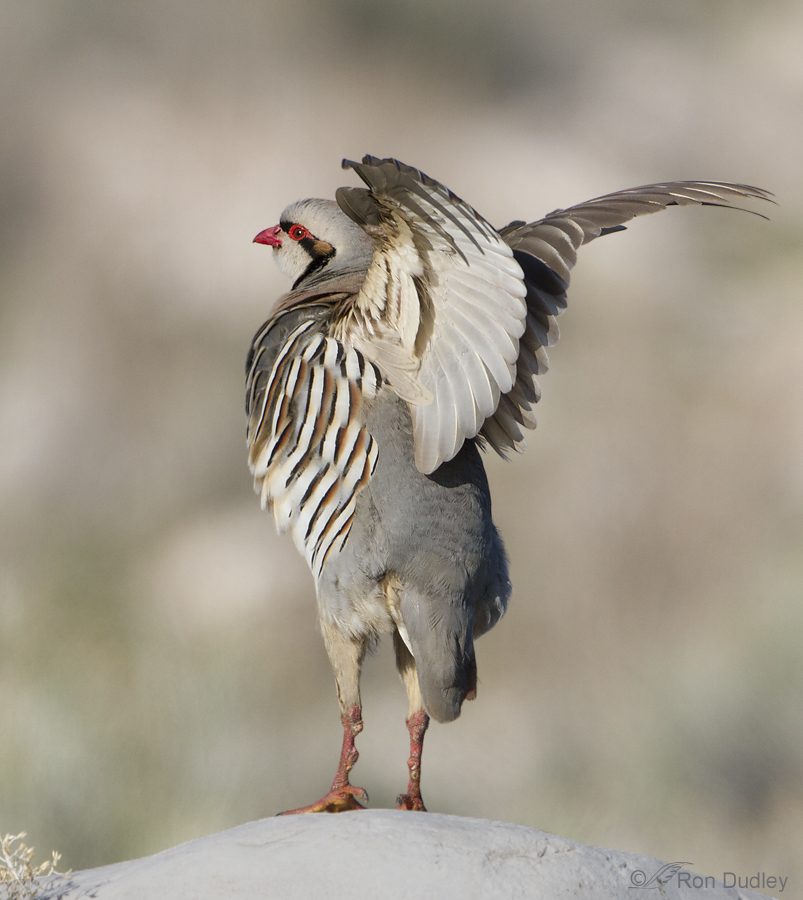
The bird was so enthusiastic about its morning stretch that it even stood on its toes at the end (reminded me of some people when they stretch).

The bird was so enthusiastic about its morning stretch that it even stood on its toes at the end (reminded me of some people when they stretch).

Willets aren’t flashy birds but right now they’re very conspicuous on Antelope Island because they’ve come up higher on the slopes for their spring mating activities.
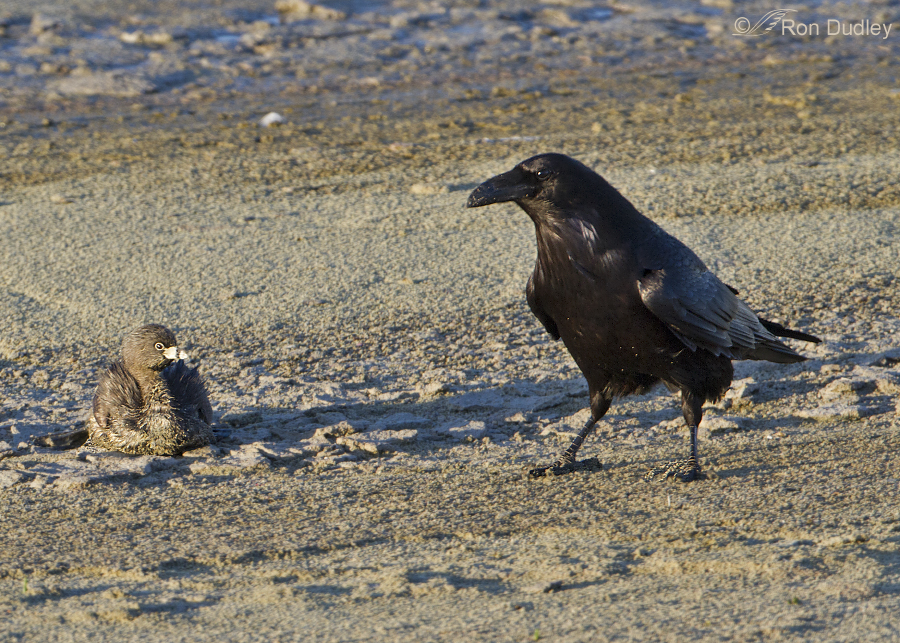
Last week as I drove along the causeway to Antelope Island just after sunup I came across a Pied-billed Grebe on the shore that was being tormented by a Common Raven. I still don’t fully comprehend what I witnessed.
Antelope Island is still teeming with Western Meadowlarks and will be for the rest of the summer. Most are uncooperative but there are exceptions.
I’ve mentioned before how very reluctant Chukars are to fly. They much prefer to scurry away through the grasses whenever they feel insecure or threatened.
And that reluctance also applies when they’re ready to leave an elevated perch. They’ll nearly always find a way to scramble down a big rock rather than fly from it like most other birds would. That tendency was demonstrated to me twice yesterday morning on Antelope Island.
Last fall I drove up just as this scenario was playing out. This guy was a biker (bicycle) who had laid his bike down on the road and approached this bison much too closely on foot to get a few photos with his point and shoot. I just knew bad stuff was going to happen so I quickly aimed my camera just as the bison charged this bozo.
The Gray Partridge has a fairly limited range in North America and most folks don’t get to see them so I thought some of my readers might be interested in a post on the species. This bird prefers the grasslands and grainfields of our northern wheat-belt so they’re fairly common on our family farm in northwest Montana.
Gray Partridges are often called Hungarian Partridges, or “Huns” for short.
Early last Sunday morning was a good time for Chukars on Antelope Island. It was too early for the weekend crowds who were mostly still home snoozing away, the light was great and the Chukars cooperative.
As I reported on my last post, Mia and I found two Mountain Plovers on Antelope Island yesterday. They’re rare in Utah and I had never seen the species before, even in my travels to Montana and Wyoming where they’re more common. It was a very exciting day.
The American Bittern may be the most elusive avian subject I’ve ever photographed. They’re solitary, cryptically colored and their preferred habitat is wetlands with tall, emergent vegetation. And they’re extremely secretive by nature. So much so that very little is known about their biology, which is too bad because perhaps if we understood them better we could more effectively manage their seriously declining populations.
A week ago today, on 3/29/13, I photographed a pair of courting Long-billed Curlews on Antelope Island. For sexual ID purposes, notice that the female of this species (on the right in this first image) is larger than the male and has a significantly longer bill. It’s also been my observation that the male is darker and redder than the female but I don’t see that mentioned in the physical descriptions in the field guides and other sources that I’ve read.
Yesterday morning there was meadowlark magic on the island. They were almost everywhere, singing lustily from atop their sagebrush and rabbitbrush perches (and more than a few ugly signposts). Several times I just stopped the truck, turned the engine off and got outside to listen. You could hear dozens of them simultaneously – some very close, some far away and others everywhere in between. Their melodious calls literally bounced off the hilltops.
Our Chukars are generally easier to approach in the spring and early summer than they are the rest of the year. Right now, pair bonds are being formed and the birds seem more concerned with others of their own kind than they are about me and my pickup.
I’m always happy when I can get decent images of an owl in flight. If they’re carrying prey it’s a bonus. And if the bird is flying toward me I often consider it icing on the cake – partly because those kinds of shots are so very often baited, decoyed, set up or called in. As always for me, these were not. I’ve posted one of these shots before but I hoped it might be interesting for some to see a sequence of images as this adult male Short-eared Owl flew toward me with a vole for its mate before veering off to my right. 1/1000, f/5.6, ISO 800, 500 f/4, 1.4 tc, natural light, not baited, set up or called in This first image shows less detail and image quality because the owl was further away as it began to approach me but I decided to include it for context in the sequence. The lower background is sagebrush flats while the upper blues are Montana’s Centennial Mountains in shade. 1/1250, f/5.6, ISO 800, 500 f/4, 1.4 tc, natural light, not baited, set up or called in Four frames later the owl was significantly closer and flew almost directly at me before veering off – a pattern it followed more than once. I’d guess that it was his way of checking me out for any potential threat before delivering the vole. 1/1000, f/5.6, ISO 800, 500 f/4, 1.4 tc, natural light, not baited, set up or called in Which he’s doing intently here. Eye contact can’t be much…
Sometimes a change of position of just a few inches can have a fairly dramatic affect on the overall “feel” of an image. That was the case with this Antelope Island Chukar. 1600, f/8, ISO 400, 500 f/4, 1.4 tc, natural light I found the bird on a rock ledge and slightly above me which gave an almost eye-level perspective that I like. Occasionally it would call, as they’re very prone to do. 1600, f/8, ISO 400, 500 f/4, 1.4 tc, natural light But then it began to walk a short distance to my right (I’m always surprised that the bottoms of their feet are yellow)… 1600, f/7.1, ISO 400, 500 f/4, 1.4 tc, natural light which brought the snow-covered hillside in the background into play. At first there was a mix of snow and blue sky back there… 2000, f/7.1, ISO 400, 500 f/4, 1.4 tc, natural light but then I deliberately raised my window a couple of inches (as usual I was shooting from my pickup) to take the blue sky out of the picture. And the bird obliged me by calling once again. Most of the snow is finally gone from the island now. Even the roads to the Frary Peak trailhead and White Rock Bay are open – they’ve been closed for months due to snow. Hopefully that’s a sign that the curlews and Willets (and other spring birds) won’t be far behind. Hope so – it’s been a long dry spell on the island. Ron