
Category: Waterfowl
Redhead Pair
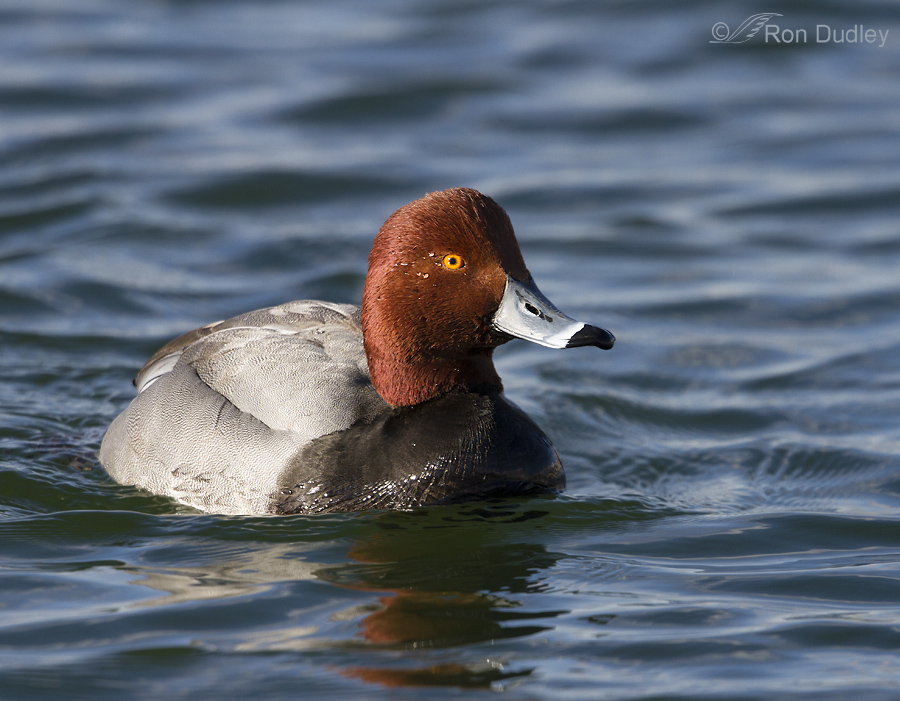
“If you’ve dated a redhead raise your glass, if not . . . raise your standards” – Anonymous.
Redheads (of the duck variety) begin to pair up on their winter range and some of the birds now migrating through my area have already formed their monogamous pair bonds.
A Survivor! Last Year’s One-footed Merganser Has Returned
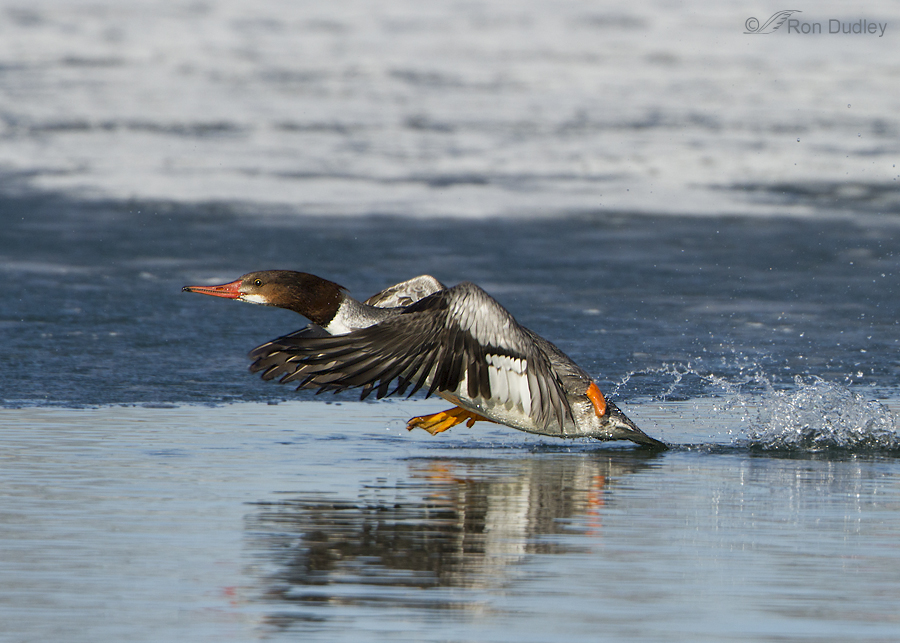
With all the recent bad news about critters suffering and dying at the hand of man it’s so refreshing to come across one who has defied the odds and not only survived, but thrived!
Gadwall Stealing Food From A Coot
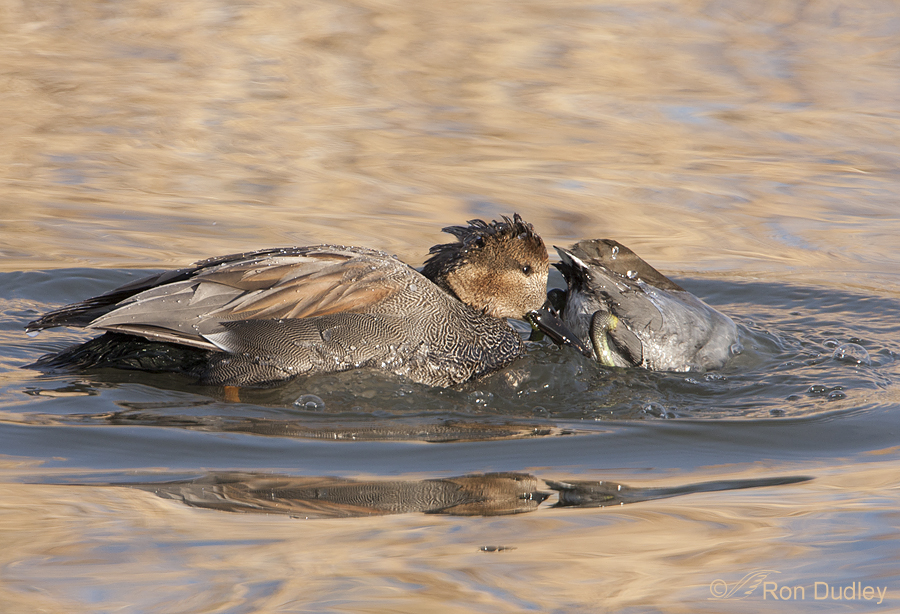
Gadwalls are well-known for stealing food (kleptoparasitism) from American Coots . They eat the same kinds of food (submerged aquatic vegetation), Gadwalls are almost a third bigger than coots and the two species often feed together in mixed flocks so being the bullies on the block, Gadwalls can’t resist taking advantage of the situation.
A Greater Yellowlegs And Its Weather Loach Prey
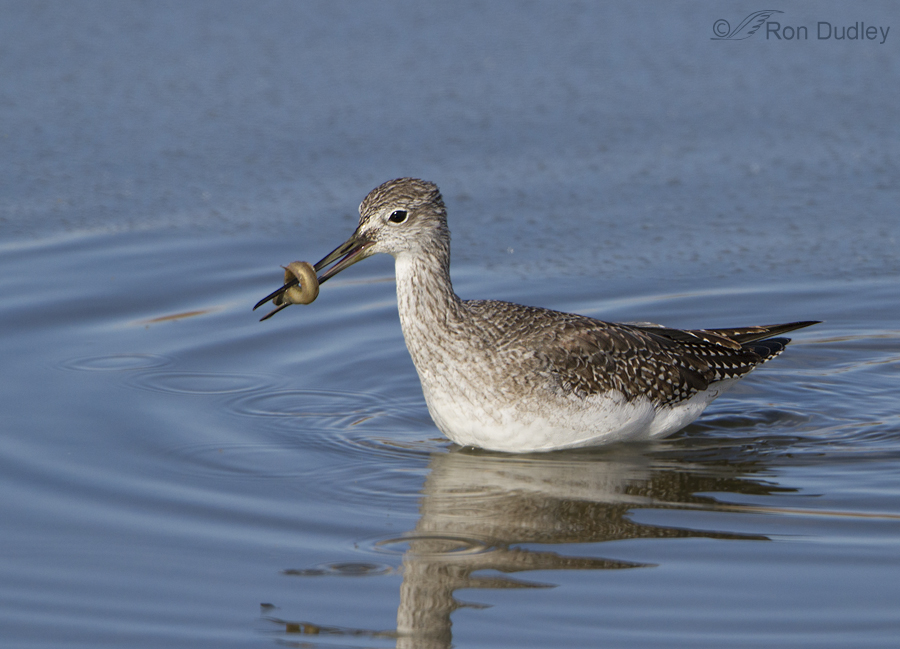
Yesterday morning we encountered several cooperative Greater Yellowlegs at Farmington Bay and this one found a rather unusual prey item.
Prairie Falcon – A Fascinating Hunting Strategy
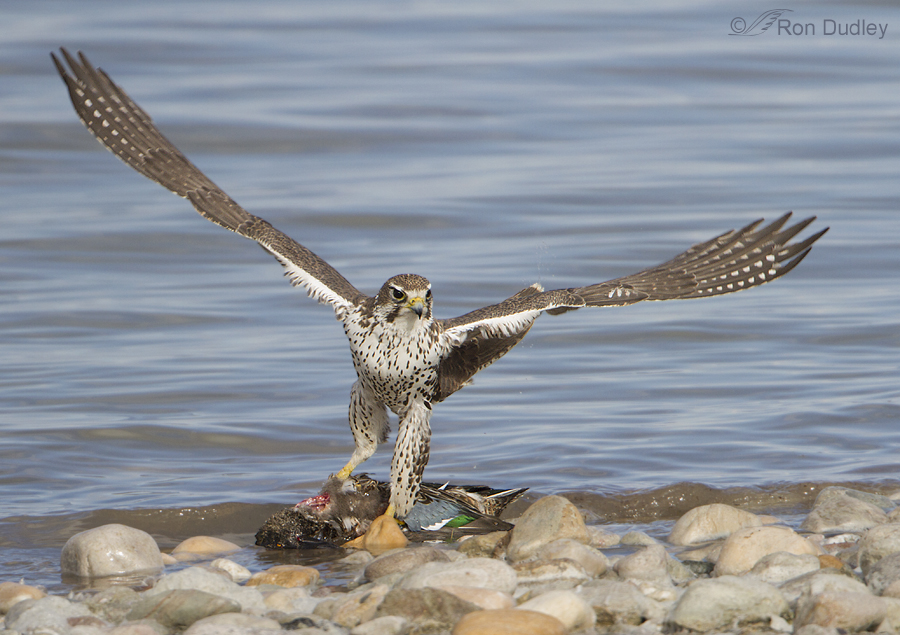
Some of you may recall that last November I photographed an amazing encounter between a Prairie Falcon and a hapless Northern Shoveler along the causeway to Antelope Island. These are photos of that experience that I haven’t posted before.
Trumpeter Swan Pair With Six Cygnets
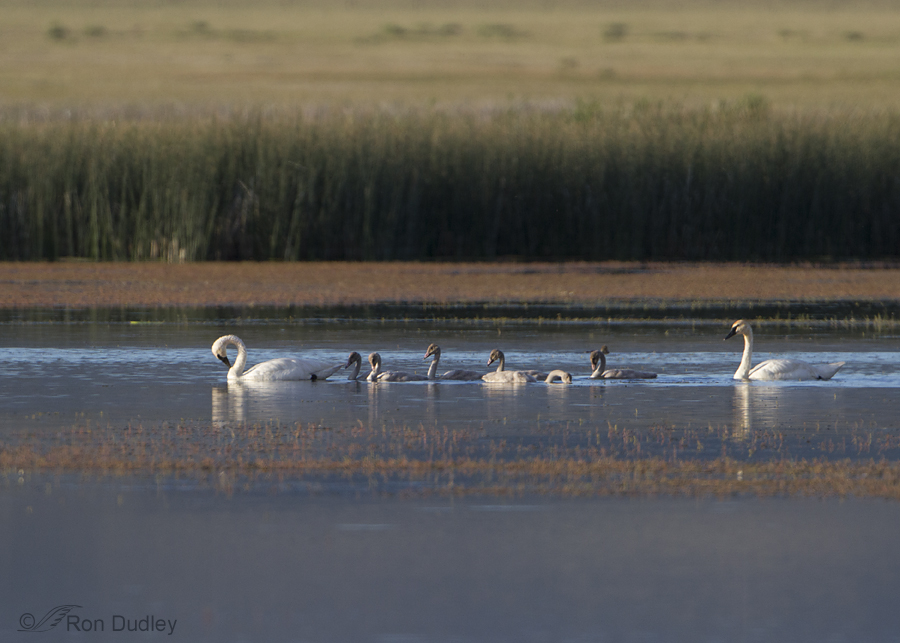
Trumpeter Swans are the largest of all North American waterfowl, weighing up to 30 pounds and having a wingspan of as much as 8 feet. It’s hard to imagine that by the 1930’s this species had been almost wiped out. In 1949 the Director of the U.S. Fish and Wildlife Service said that the Trumpeter Swan was “the fourth rarest bird now remaining in America”. But thankfully recent intense swan restoration and management programs have brought the species back from the brink of extinction.
Canvasbacks – Feeding and Fighting
Because of its striking appearance the Canvasback is often referred to as the “aristocrat” of ducks. But as you’ll see, it’s difficult to look aristocratic with your face, head and neck slathered in mud.
One Red-tailed Hawk, Six Canada Geese and One Huge Commotion
Last week, Mia and I enjoyed our first camping/photo trip of the season. We explored some remote areas of northern Utah and even found some interesting birds. But the incident I’m reporting on here still has me a bit perplexed.
Promised Update On Mergansers Entangled In Fishing Line
Some of you may remember that on February 17th I posted about the problem of birds getting caught in discarded fishing line at Willow Pond, one of our urban fisheries here in Murray, Utah. I had photographed some Common Mergansers that had fishing line entangled on their bodies and fish hooks stuck in their bills. This merganser had lost a foot to fishing line. Another had a fish-hook stuck in its bill and other ducks had line wrapped around their legs and wings. Here’s a link to that original post: https://featheredphotography.com/blog/2013/02/17/one-footed-merganser-in-a-hurry/#comment-21517 In comments, many of you were as disturbed as I was about the carelessness of anglers and the resulting suffering of birds and some suggested a variety of methods to help address the issue. I chose to contact Tom Wharton, a long-time and highly respected columnist for the Salt Lake Tribune, to see if he was interested in doing a story on the situation at Willow Pond. When I sent him a link to the merganser post he responded almost immediately and asked if I would meet him at the pond and give him some background. So a couple of days later Mia and I met him at the pond and spent most of an hour with him reviewing the situation. He was enthusiastic about writing a column on the subject and trying to help birds. That column was published three days ago but I’ve been on a camping/photo trip and couldn’t post about it until now. But since many of you had asked me to update any developments…
The Prairie Falcon And The Northern Shoveler
Back in November I blogged about my encounter with a Prairie Falcon and its Northern Shoveler prey. I thought that some of the images I didn’t use back then were worthy of another post. This falcon struck the duck on the water, then waited for it to die and to be washed up onto shore. 1/2500, f/6.3, ISO 640, 500 f/4, 1.4 tc, natural light, not baited, set up or called in It attempted to enjoy its meal at the water’s edge but waves kept coming in and “rocking the boat”… 1/2500, f/6.3, ISO 640, 500 f/4, 1.4 tc, natural light, not baited, set up or called in so the falcon decided to drag the shoveler further up the rocky shore and away from the annoying waves. 1/2500, f/6.3, ISO 640, 500 f/4, 1.4 tc, natural light, not baited, set up or called in It wasn’t an easy task. Average weight for Northern Shovelers is almost as much as it is for Prairie Falcons (1.3 vs 1.6 lbs) so the falcon really struggled in its attempt to drag the duck to a more suitable dining area. 1/2500, f/6.3, ISO 640, 500 f/4, 1.4 tc, natural light, not baited, set up or called in I thought this was an interesting shot with the wings up, the left foot off the ground and direct eye contact. 1/2500, f/6.3, ISO 640, 500 f/4, 1.4 tc, natural light, not baited, set up or called in Finally the falcon was satisfied with the…
Attack Of The Shoveler
Most Northern Shovelers breed far north of my area (northern Utah) so I rarely get to see their intensely agonistic breeding behaviors but I’ve seen and photographed some of it in mid-June at Red Rock Lakes National Wildlife Refuge in sw Montana. Northern Shovelers are the most territorial of all dabbling ducks and the sexes remain paired longer than any other species. Both of these factors contribute to their aggressive natures. These three sequential shots don’t have great image quality but I do think they illustrate some interesting behavior. 1/2000, f/7.1, ISO 500, 500 f/4, 1.4 tc I’d been photographing Short-eared Owls from my pickup but was aware of some activity from shovelers in the marshy grasses nearby. A commotion got my attention just in time to see the male on the right fly in to attack another male on the water. The second bird saw the attack coming and decided that discretion was the better part of valor and rose from the water in a hasty retreat. I like the non-plussed look of the retreating bird. 1/2000, f/7.1, ISO 500, 500 f/4, 1.4 tc In this second image of the series it’s not clear if the open bill of the incoming bird is due to aggressive vocalization or an attempt to bite the other male. 1/2000, f/7.1, ISO 500, 500 f/4, 1.4 tc But in this last image I think it becomes obvious that the intent was to bite the retreating duck. Bird behaviors fascinate me. They’re often both interesting and entertaining but many of…
One-footed Merganser In A Hurry
I live near a local fishing pond that attracts a few fish-eating birds, particularly in the late winter and early spring. For the last few days there’s been a pair of Common Mergansers on the pond and yesterday morning I was finally able to get relatively close to them for a few minutes. The pond was still about half covered with ice but it’s melting fast. 1/2500, f/7.1, ISO 500, 500 f/4, 1.4 tc, natural light Most of the time there wasn’t much action with the cormorants but once, when this bird apparently thought its companion might have caught a fish, it rushed over to investigate. It wasn’t until this morning when I began culling and processing the images that I noticed that it was missing its left foot. 1/2500, f/7.1, ISO 500, 500 f/4, 1.4 tc, natural light Since they use their webbed feet to help propel them along the surface of the water this bird could really scoot for having only one foot. 1/2500, f/7.1, ISO 500, 500 f/4, 1.4 tc, natural light This image shows the missing foot best. 1/2000, f/7.1, ISO 500, 500 f/4, 1.4 tc, natural light This shot, and the next two, are of the other merganser. As you can see it had some kind of fishing lure/hook stuck in its lower mandible. It doesn’t look like a typical lure so perhaps it’s what’s left of a fish that it had tried to swallow when the hook and/or line got stuck in its bill. 1/2000, f/7.1, ISO 500, 500…
Coots Don’t Like Redheads
Last spring I witnessed quite the little drama between an American Coot and a mated pair of Redheads. I’m going to be a little anthropomorphic here with my narrative (and even my title) – sorry, just can’t resist. The Redheads seemed to be minding their own business but this coot took exception when they came too close to its nest. Here the coot is apparently looking away from the ducks but the Redheads seems to know that something’s potentially up. And it was. I’m always amazed at how fast the reactions of birds are. The Redhead almost seemed to know the attack was in progress before it actually was. You’ll notice that the coot is no closer to him in this second shot than it was in the previous one. The Redhead seems to be trying to use some of the reeds to avoid the approaching coot. The attack continues… and continues… until both birds sense that it’s over and begin to settle back down into the water. The male Redhead reacts with what seems like a celebratory wing-flap that it survived the attack without any damage… and then swims off contentedly with his lady. But the coot isn’t taking any chances and lays low in the water while facing the retreating ducks with a threat pose. I was pleased to get this sequence without clipping any birds and keeping multiple subjects sharp in the frame – not easy to do…
Mallard Reflection
“Reflecting” my need to work with an image with some color for a change (after all of the snow, brutal cold and gray skies we’ve been having) and also inspired by some recent discussion with blog reader Sue Johnson regarding reflections, I’ve chosen to post something this morning that’s a little different for me. Last July I found this wild female Mallard posing and preening on a perch I liked and in warm, early morning light. 1/320, f/6.3, ISO 500, 500 f/4, 1.4 tc, natural light As I gained experience as a photographer I found myself gravitating away from reflections, often preferring instead the fine detail typically available in traditional portraits. But for my tastes, this image provides both – good detail and a strong reflection. I like the setting, pose, perch, light and reflection. In fact I like the reflection (bird and water colors) at least as much as I do the live bird. The image may be a little tight for some but it’s very close to full frame, shot vertically, and I just didn’t have as much wiggle room as I would have liked. I thought I’d present the image for your consideration anyway… Ron
-

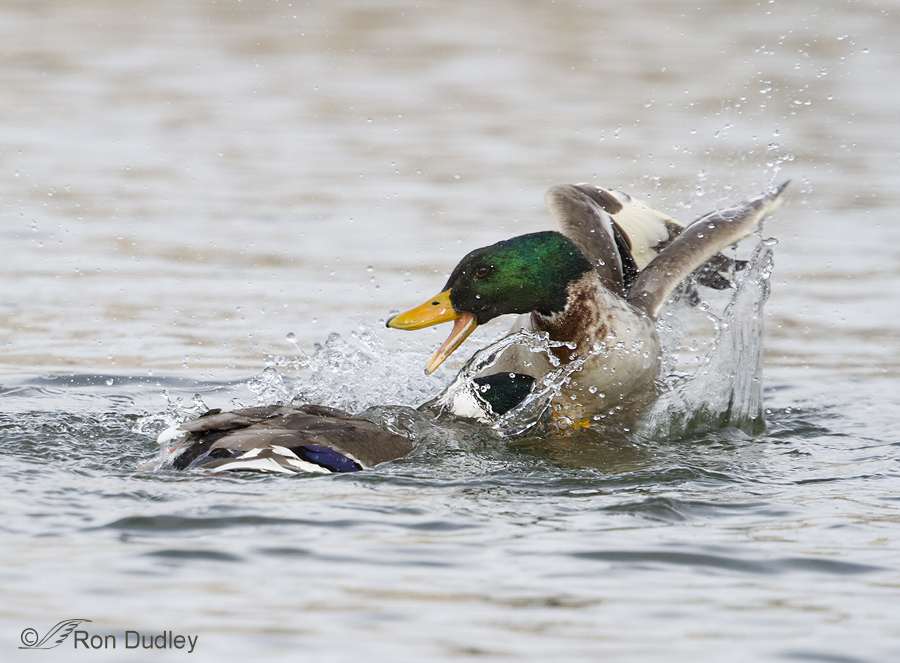
Redhead Pair
“If you’ve dated a redhead raise your glass, if not . . . raise your standards” – Anonymous.
Redheads (of the duck variety) begin to pair up on their winter range and some of the birds now migrating through my area have already formed their monogamous pair bonds.
A Survivor! Last Year’s One-footed Merganser Has Returned
With all the recent bad news about critters suffering and dying at the hand of man it’s so refreshing to come across one who has defied the odds and not only survived, but thrived!
Gadwall Stealing Food From A Coot
Gadwalls are well-known for stealing food (kleptoparasitism) from American Coots . They eat the same kinds of food (submerged aquatic vegetation), Gadwalls are almost a third bigger than coots and the two species often feed together in mixed flocks so being the bullies on the block, Gadwalls can’t resist taking advantage of the situation.
A Greater Yellowlegs And Its Weather Loach Prey
Yesterday morning we encountered several cooperative Greater Yellowlegs at Farmington Bay and this one found a rather unusual prey item.
Prairie Falcon – A Fascinating Hunting Strategy
Some of you may recall that last November I photographed an amazing encounter between a Prairie Falcon and a hapless Northern Shoveler along the causeway to Antelope Island. These are photos of that experience that I haven’t posted before.
Trumpeter Swan Pair With Six Cygnets
Trumpeter Swans are the largest of all North American waterfowl, weighing up to 30 pounds and having a wingspan of as much as 8 feet. It’s hard to imagine that by the 1930’s this species had been almost wiped out. In 1949 the Director of the U.S. Fish and Wildlife Service said that the Trumpeter Swan was “the fourth rarest bird now remaining in America”. But thankfully recent intense swan restoration and management programs have brought the species back from the brink of extinction.
Canvasbacks – Feeding and Fighting
Because of its striking appearance the Canvasback is often referred to as the “aristocrat” of ducks. But as you’ll see, it’s difficult to look aristocratic with your face, head and neck slathered in mud.
One Red-tailed Hawk, Six Canada Geese and One Huge Commotion
Last week, Mia and I enjoyed our first camping/photo trip of the season. We explored some remote areas of northern Utah and even found some interesting birds. But the incident I’m reporting on here still has me a bit perplexed.
Promised Update On Mergansers Entangled In Fishing Line
Some of you may remember that on February 17th I posted about the problem of birds getting caught in discarded fishing line at Willow Pond, one of our urban fisheries here in Murray, Utah. I had photographed some Common Mergansers that had fishing line entangled on their bodies and fish hooks stuck in their bills. This merganser had lost a foot to fishing line. Another had a fish-hook stuck in its bill and other ducks had line wrapped around their legs and wings. Here’s a link to that original post: https://featheredphotography.com/blog/2013/02/17/one-footed-merganser-in-a-hurry/#comment-21517 In comments, many of you were as disturbed as I was about the carelessness of anglers and the resulting suffering of birds and some suggested a variety of methods to help address the issue. I chose to contact Tom Wharton, a long-time and highly respected columnist for the Salt Lake Tribune, to see if he was interested in doing a story on the situation at Willow Pond. When I sent him a link to the merganser post he responded almost immediately and asked if I would meet him at the pond and give him some background. So a couple of days later Mia and I met him at the pond and spent most of an hour with him reviewing the situation. He was enthusiastic about writing a column on the subject and trying to help birds. That column was published three days ago but I’ve been on a camping/photo trip and couldn’t post about it until now. But since many of you had asked me to update any developments…
The Prairie Falcon And The Northern Shoveler
Back in November I blogged about my encounter with a Prairie Falcon and its Northern Shoveler prey. I thought that some of the images I didn’t use back then were worthy of another post. This falcon struck the duck on the water, then waited for it to die and to be washed up onto shore. 1/2500, f/6.3, ISO 640, 500 f/4, 1.4 tc, natural light, not baited, set up or called in It attempted to enjoy its meal at the water’s edge but waves kept coming in and “rocking the boat”… 1/2500, f/6.3, ISO 640, 500 f/4, 1.4 tc, natural light, not baited, set up or called in so the falcon decided to drag the shoveler further up the rocky shore and away from the annoying waves. 1/2500, f/6.3, ISO 640, 500 f/4, 1.4 tc, natural light, not baited, set up or called in It wasn’t an easy task. Average weight for Northern Shovelers is almost as much as it is for Prairie Falcons (1.3 vs 1.6 lbs) so the falcon really struggled in its attempt to drag the duck to a more suitable dining area. 1/2500, f/6.3, ISO 640, 500 f/4, 1.4 tc, natural light, not baited, set up or called in I thought this was an interesting shot with the wings up, the left foot off the ground and direct eye contact. 1/2500, f/6.3, ISO 640, 500 f/4, 1.4 tc, natural light, not baited, set up or called in Finally the falcon was satisfied with the…
Attack Of The Shoveler
Most Northern Shovelers breed far north of my area (northern Utah) so I rarely get to see their intensely agonistic breeding behaviors but I’ve seen and photographed some of it in mid-June at Red Rock Lakes National Wildlife Refuge in sw Montana. Northern Shovelers are the most territorial of all dabbling ducks and the sexes remain paired longer than any other species. Both of these factors contribute to their aggressive natures. These three sequential shots don’t have great image quality but I do think they illustrate some interesting behavior. 1/2000, f/7.1, ISO 500, 500 f/4, 1.4 tc I’d been photographing Short-eared Owls from my pickup but was aware of some activity from shovelers in the marshy grasses nearby. A commotion got my attention just in time to see the male on the right fly in to attack another male on the water. The second bird saw the attack coming and decided that discretion was the better part of valor and rose from the water in a hasty retreat. I like the non-plussed look of the retreating bird. 1/2000, f/7.1, ISO 500, 500 f/4, 1.4 tc In this second image of the series it’s not clear if the open bill of the incoming bird is due to aggressive vocalization or an attempt to bite the other male. 1/2000, f/7.1, ISO 500, 500 f/4, 1.4 tc But in this last image I think it becomes obvious that the intent was to bite the retreating duck. Bird behaviors fascinate me. They’re often both interesting and entertaining but many of…
One-footed Merganser In A Hurry
I live near a local fishing pond that attracts a few fish-eating birds, particularly in the late winter and early spring. For the last few days there’s been a pair of Common Mergansers on the pond and yesterday morning I was finally able to get relatively close to them for a few minutes. The pond was still about half covered with ice but it’s melting fast. 1/2500, f/7.1, ISO 500, 500 f/4, 1.4 tc, natural light Most of the time there wasn’t much action with the cormorants but once, when this bird apparently thought its companion might have caught a fish, it rushed over to investigate. It wasn’t until this morning when I began culling and processing the images that I noticed that it was missing its left foot. 1/2500, f/7.1, ISO 500, 500 f/4, 1.4 tc, natural light Since they use their webbed feet to help propel them along the surface of the water this bird could really scoot for having only one foot. 1/2500, f/7.1, ISO 500, 500 f/4, 1.4 tc, natural light This image shows the missing foot best. 1/2000, f/7.1, ISO 500, 500 f/4, 1.4 tc, natural light This shot, and the next two, are of the other merganser. As you can see it had some kind of fishing lure/hook stuck in its lower mandible. It doesn’t look like a typical lure so perhaps it’s what’s left of a fish that it had tried to swallow when the hook and/or line got stuck in its bill. 1/2000, f/7.1, ISO 500, 500…
Coots Don’t Like Redheads
Last spring I witnessed quite the little drama between an American Coot and a mated pair of Redheads. I’m going to be a little anthropomorphic here with my narrative (and even my title) – sorry, just can’t resist. The Redheads seemed to be minding their own business but this coot took exception when they came too close to its nest. Here the coot is apparently looking away from the ducks but the Redheads seems to know that something’s potentially up. And it was. I’m always amazed at how fast the reactions of birds are. The Redhead almost seemed to know the attack was in progress before it actually was. You’ll notice that the coot is no closer to him in this second shot than it was in the previous one. The Redhead seems to be trying to use some of the reeds to avoid the approaching coot. The attack continues… and continues… until both birds sense that it’s over and begin to settle back down into the water. The male Redhead reacts with what seems like a celebratory wing-flap that it survived the attack without any damage… and then swims off contentedly with his lady. But the coot isn’t taking any chances and lays low in the water while facing the retreating ducks with a threat pose. I was pleased to get this sequence without clipping any birds and keeping multiple subjects sharp in the frame – not easy to do…
Mallard Reflection
“Reflecting” my need to work with an image with some color for a change (after all of the snow, brutal cold and gray skies we’ve been having) and also inspired by some recent discussion with blog reader Sue Johnson regarding reflections, I’ve chosen to post something this morning that’s a little different for me. Last July I found this wild female Mallard posing and preening on a perch I liked and in warm, early morning light. 1/320, f/6.3, ISO 500, 500 f/4, 1.4 tc, natural light As I gained experience as a photographer I found myself gravitating away from reflections, often preferring instead the fine detail typically available in traditional portraits. But for my tastes, this image provides both – good detail and a strong reflection. I like the setting, pose, perch, light and reflection. In fact I like the reflection (bird and water colors) at least as much as I do the live bird. The image may be a little tight for some but it’s very close to full frame, shot vertically, and I just didn’t have as much wiggle room as I would have liked. I thought I’d present the image for your consideration anyway… Ron