
Adult Female Magpie Begging For Food
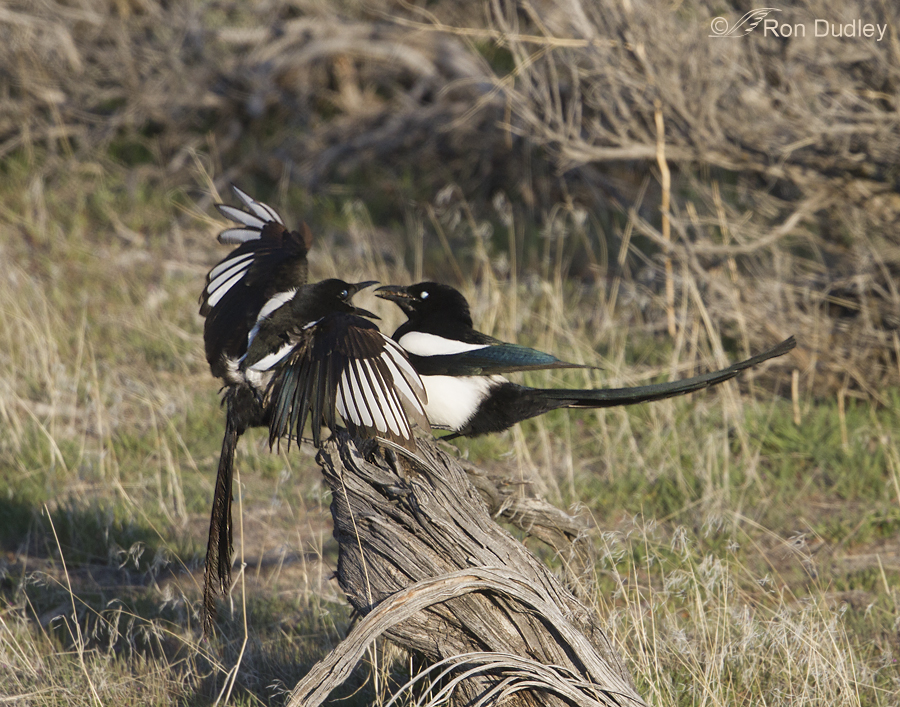
Female Black-billed Magpies beg aggressively for food from the male prior to and during incubation.

Female Black-billed Magpies beg aggressively for food from the male prior to and during incubation.
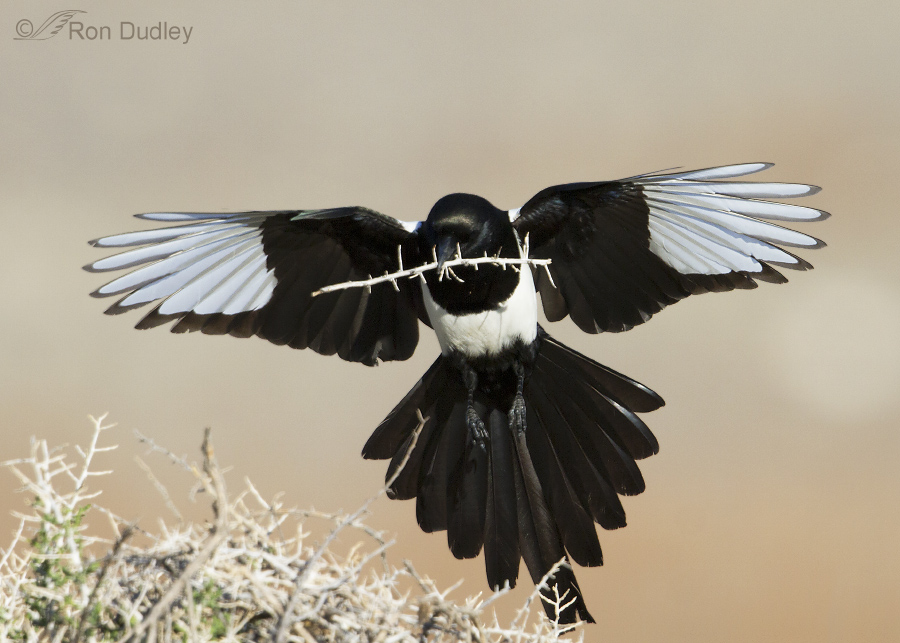
Photographing birds as they take off is tricky but with a little luck and perseverance it can be done. Landing shots are much more difficult and often require creative innovation.
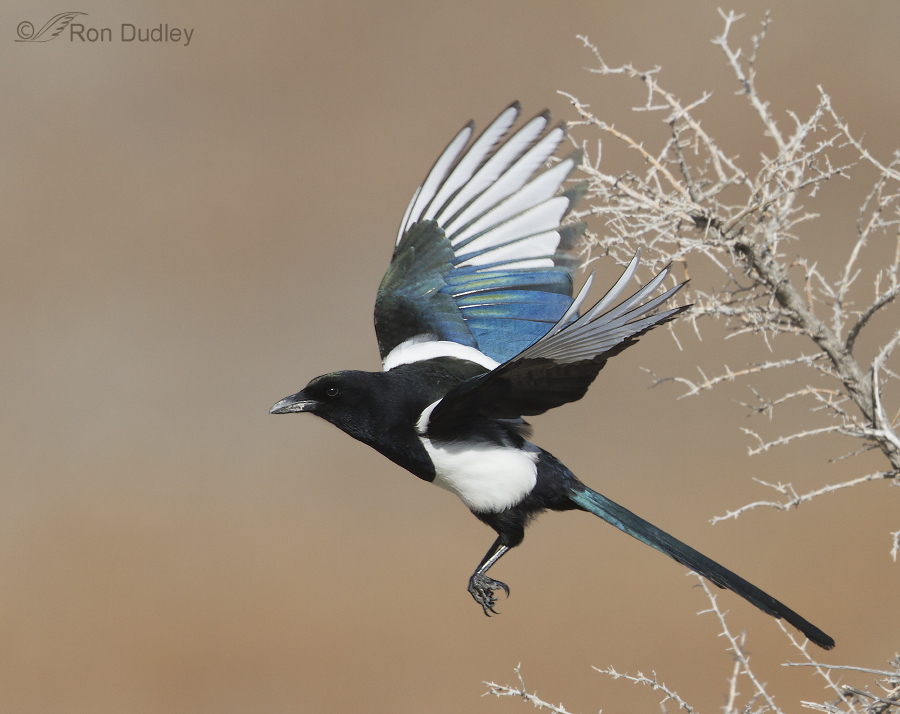
Around here Black-billed Magpies are among the first species to begin nest-building activities. It tickles my fancy to see another sign of spring after this miserable winter.
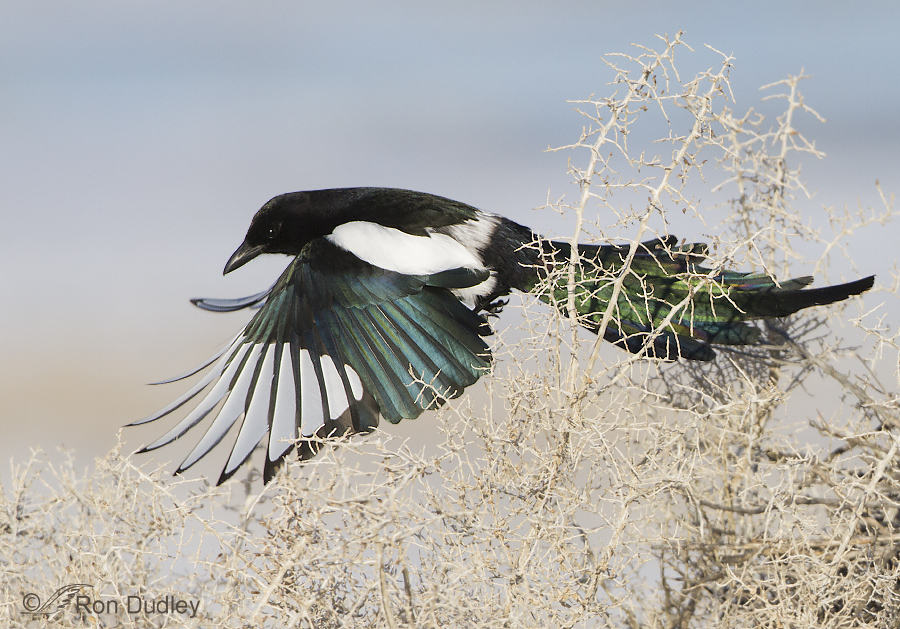
By definition there is often a price to be paid for ethical nature photography since the image you get may not be the one you envisioned or hoped for.
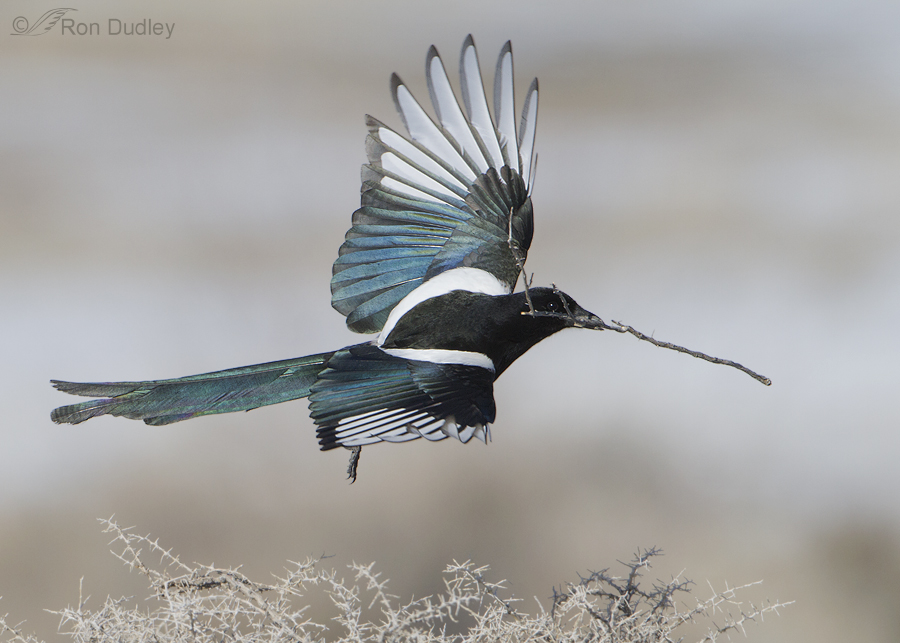
One of the reasons I like to see iridescence in Black-billed Magpies is that it brings out detail in those areas of the deep blacks where you normally don’t see any. Flight shots are inherently more difficult than static shots but ironically I find it easier to get the iridescence to show in flight than I do when they’re perched.
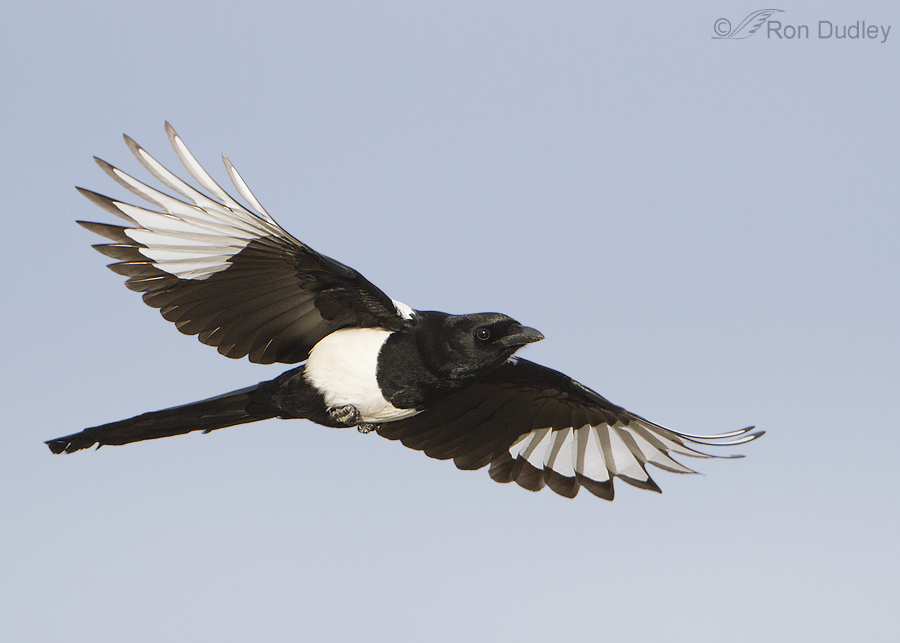
Magpies aren’t among the most glamorous of birds so they don’t get a lot of attention from photographers but I enjoy them for their fascinating behaviors, their gutsiness and their apparent intelligence. And if you want a particularly challenging photographic subject you can’t go wrong with the Black-billed Magpie.
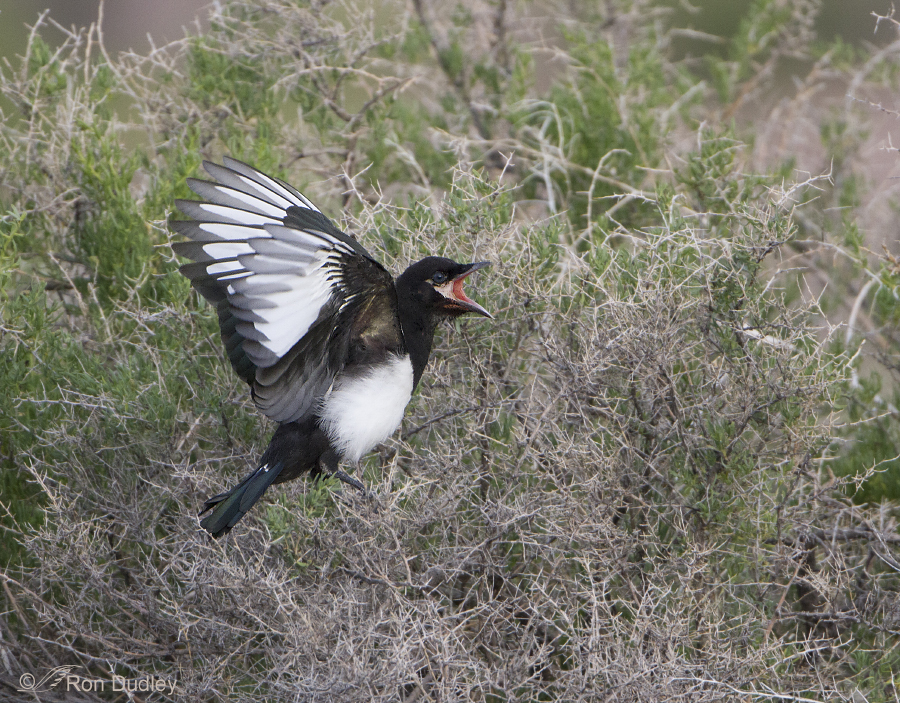
I’ve been watching a Black-billed Magpie nest in a greasewood bush on Antelope Island all spring but the adults are very spooky and always fly off as I approach (the nest is very near a road and I stay in my vehicle on the road). But I’ve been looking forward to seeing the fledglings and I finally got a good look at all five of them last week.
This post is largely about behavior. The image quality ranges from good to mediocre but I think each photo contributes something to a better understanding of magpies. Black-billed Magpies begin nest-building as early as January and these particular birds have been at it for several weeks now. Actually, in this case it’s more a “remodel” than it is “new construction” since this nest has been used for at least the last three years. All of these photos have been taken this week, which accounts for the relatively bright snow and ice background in some of the shots. 1/2500, f/7.1, ISO 500, 500 f/4, natural light One of the first things you may notice is the fact that sometimes these Black-billed Magpies don’t seem to have black bills. Part of nest construction involves mud gathering and the drying mud on the bill can significantly alter the appearance of the bill. 1/2500, f/7.1, ISO 500, 500 f/4, natural light Both sexes contribute to nest construction and they’re quite industrious in their efforts. The size of the twigs they bring in is often impressive. 1/4000, f/7.1, ISO 500, 500 f/4, natural light The nest is buried deep in a greasewood bush at about eye level for me. Typically a bird bringing in construction material will land on a nearby perch and look over the nest for a few moments – seeming to plan placement of the twig and an approach path through the myriad of vertical greasewood stems that present significant obstacles to proper placement of such an unwieldy…
I’ve spent the last two mornings photographing Black-billed Magpies in the midst of nest construction. These birds often re-use old nests and this is at least the third year they have used the same one. Even when “recycling” the nest like this, weeks of work go in to refurbishing it – they bring in a completely new lining of grass, mud, rootlets and even bison fur. And they add an amazing number of new twigs to the basic structure. These are industrious birds! I’ve said before that this species is my most challenging avian photographic subject and that fact has been reinforced this week. There are several reasons for that, including: the deep black and bright white combination is hugely difficult to expose properly that aggravatingly long tail makes composition difficult and it is very easy to clip or cut off in action shots they close their nictitating membrane more than any other bird I’ve photographed and when they do its color is a blue-white which is almost shockingly apparent against the black head when they take off from an elevated perch they typically flap once and then fold their wings tightly against the body at exactly the moment when it’s easiest to get them in flight, resulting in what I call a “torpedo-bird” flight posture that is less than desirable the dark eye set against a black head makes it very difficult to get a good catch light in the eye In the last two days I’ve taken over 1200 shots of these magpies and about 95% of them were garbage, largely due…
Black-billed Magpies are loud, flashy and conspicuous black and white birds. And they’re a challenge to photograph well because of the exposure difficulty – getting detail in the blacks without “blowing out” the whites. I probably discard a higher proportion of shots of this species than I do any other. But if you work hard at it (with a little luck thrown into the mix) you can get some pretty spectacular shots that have detail in the blacks and whites and their showy iridescence. The actual plumage of these birds is truly black and white, with no other colors. But in the right light the feather structure (and other factors) on the tail and wings of these birds bends the light much like a prism and produces a variety of colors, predominantly blues and greens. When I’m photographing magpies, one of my goals is usually to capture some of that iridescence. 1/4000, f/6.3, ISO 500, 100-400 @ 400mm, natural light Three days ago I found this magpie perched on a snow-covered boulder on Antelope Island. As you can see the whites are well-exposed but there’s not a lot of detail in the blacks. This is the type of magpie image that I normally wouldn’t do much with except for purposes such as this post (my high shutter speeds were due to the snow and the fact that I was attempting take-off shots). 1/4000, f/6.3, ISO 500, 100-400 @ 400mm, natural light This is the same bird on the same perch but the image was taken…
I have an appointment early this morning so I don’t have time for a detailed, organized post so I thought I’d present a little potpourri from the last few weeks. Though none of these images are spectacular, there’s something about each one of them that appealed to me in some way. Common Ravens are a hugely challenging subject for me because of their uncooperative behavior and the difficulty of getting detail in the blacks. For some reason, these birds really seem to eat a lot of snow, which this one had been doing just before take-off. I do wish the head were slightly sharper but I like the remnants of the snow-eating behavior and how cleanly the bird is presented against the background which is the Great Salt Lake with the snow-covered shoreline at bottom right. Finding water that isn’t ice-covered around here isn’t easy, for me or for the critters, but I think that’s the only reason this Muskrat came as close to me as it did. I found this one at a pond close to my home. Ok, not a classic wing position for sure but the aerodynamic profile of this fast flying Prairie Falcon still appealed to me. I also like the eye contact and crisp detail in flight. Life is tough for Coyotes right now as they live in a stark white world of deep snow which makes survival difficult. Many of them wear an almost perpetual snow mask from pushing their faces through the snow as they try to follow…
Yesterday Mia and I returned from a three day camping and photo trip to Flaming Gorge. We had great weather for most of our time there and as usual the scenery and ambience were awesome. At an elevation over 6000′ many of the birds that we usually see there apparently haven’t arrived yet but we spent some quality time with a pair of nesting Osprey – a species that I’ve had little luck with in the past. 1/2000, f/5.6, ISO 500, 500 f/4, 1.4 tc This pole with all the attached ugly hardware was within a few feet of the nesting platform and early one morning this Osprey landed on the pole with a freshly caught fish. At first I figured that this bird would deliver the fish to its mate on the nest (I have a lot to learn about this species) but it didn’t. It’s intention was to eat the fish itself but as you’ll see, those plans were delayed by an interloper. It didn’t take long for this Black-billed Magpie to show up and torment the rightful owner of the fish. This Osprey removed and dropped the intestines in pieces and it seemed obvious to me that the magpie had learned that particular feeding pattern and came looking for tidbits that had landed on the wires below the Osprey. Here you can see one of those bits in the beak of the magpie that it had picked off of the metal above its head. So far the Osprey doesn’t seem too…
Black-billed Magpies aren’t appreciated by everyone. Their raucous behavior and scavenging habits put some folks off but I’m quite fond of them for their relatively high intelligence and incredibly interesting behaviors (examples – they conduct ritualistic “funerals” of up to 40 birds around the dead bodies of other magpies and you haven’t lived until you’ve seen one tormenting a cat by repeatedly pulling its tail). That said, they’re very difficult photographic subjects. Their black plumage soaks in the light while the bright white feathers reflect nearly all of it so getting exposure and detail in the overall bird is incredibly challenging. I probably delete a higher percentage of images I take of magpies than I do of any other species I regularly photograph which makes getting an image I like especially rewarding . I enjoy meeting the challenge… 1/1250, f/8, ISO 500, 500 f/4 When the light’s at the right angle you can sometimes get impressive iridescence in the blacks which also helps to bring out some of the detail there. This bird had just taken off from the sagebrush that its nest is deeply buried in. And it was even considerate enough to give me a pleasing head turn and eye contact as it did so. I’ve photographed this bird and its mate at their nesting site for three years now (and yes I’m very careful not to disturb them). Can’t wait for early spring to try it again. Ron
Antelope Island is ablaze with color this fall, provided by the common sunflower Helianthus annus. The sunflower display is really quite spectacular this year – the most prolific I’ve ever seen it. I suspect it’s because of the very wet spring we’ve had. The sunflowers can provide a very pleasing setting for wildlife photography, whether the flowers are in focus along with your subject or out of focus to show off some pleasing and unusual color in the background bokeh. Canon 40D @ 72mm, 1/800, f/6.3, ISO 320, EV +0.33 It’s unusual for me to get so close to a pronghorn that I don’t have to use a telephoto lens but these bucks are in rut right now and they’re so intent on herding their harem of females that they’re not nearly so wary of people and vehicles. So I quickly pulled out my old 40D and shot this handsome fella at only 72mm while he was right next to my pickup and staring intently at his ladies close by. This allowed me to keep many of the sunflowers relatively sharp and gave a different “feel” to the image than I usually get with my big glass. Canon 7D, 1/2500, f/5.6, ISO 640, EV + 0.33, 500 f/4, 1.4 tc In contrast to the previous image, this Vesper Sparrow was shot with my 500mm and 1.4 teleconverter (1120mm with the crop factor of the 7D) at f/5.6 which gave me very little depth of field – just enough to get the sparrow sharp but the sunflowers in the background…
Recent reports from others indicate that bird activity on Antelope Island is slowing down now and our experience out there recently would agree with that assessment so yesterday when Mia and I were trying to decide where to go shooting birds we were a little hesitant about another trip to the island. But even with things slowing down we almost never fail to find something interesting to photograph and yesterday was certainly no exception! Canon 7D, 1/800, f/7.1, ISO 500, EV 0, 500 f/4, 1.4 tc Soon after arriving on the island we noticed a pair of Short-eared Owls, obviously mated based on their behavior. Canon 7D, 1/1000, f/7.1, ISO 500, EV 0, 500 f/4, 1.4 tc This owl was carrying a vole and we immediately suspected that the pair had a nest in the vicinity, which turned out to be true. It was quite a distance from the road and buried in vegetation but we could tell its location by watching this owl deliver food to the nest site – either to the mate or to both the mate and chicks. We watched and photographed the birds for a while but when things slowed down we went further down the island. Canon 7D, 1/1600, f/8, ISO 640, EV + .67, 500 f/4, 1.4 tc On our return to the area of the nest we immediately saw a quickly developing drama. A young coyote had apparently just crossed the road and was approaching the nest area and the owls were in…