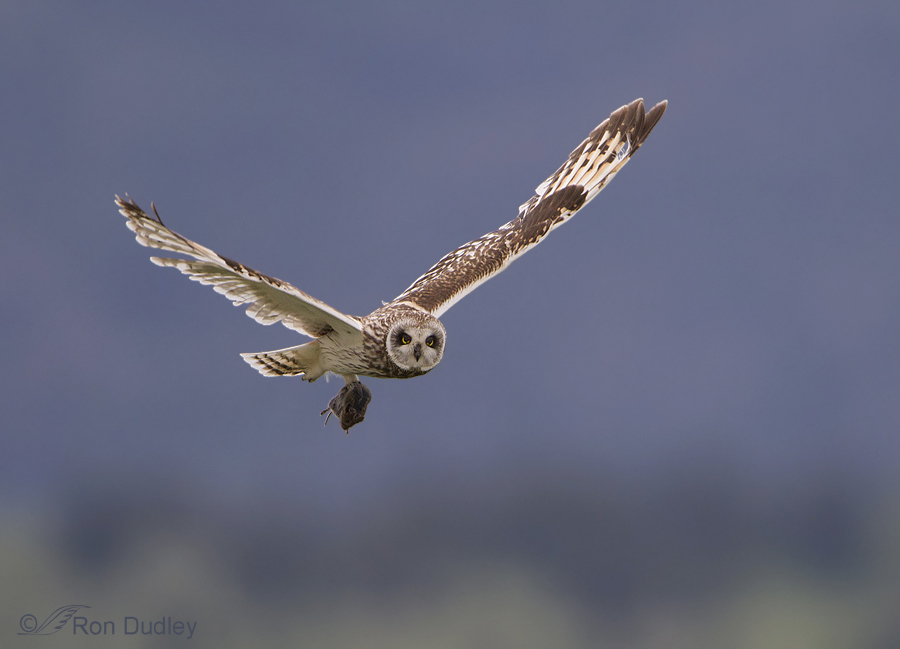
Short-eared Owls And The “Handedness Phenomenon”

Handedness is a preference for using one hand (or limb) as opposed to the other. It’s a phenomenon many of us associate strictly with humans but other vertebrates can also show handedness, including birds. For example, many parrot species have a strong and consistent preference for using their left foot when bringing food to the beak.

Based on my own observations in the field I believe that Short-eared Owls may also display handedness.

Continue reading

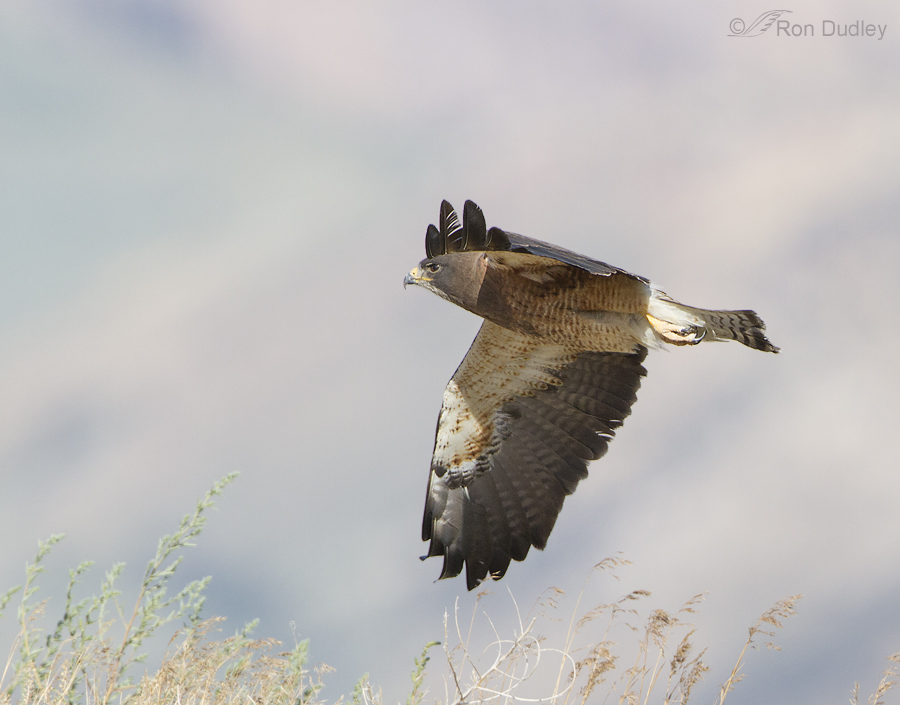
Swainson’s Hawk Optical Illusion

Each time I look at this image, at first the wing above the head appears to be the birds right wing on the far side of the body. But then a few seconds later my brain tells me that’s impossible because the lower wing is obviously the right wing and it’s impossible (or at least highly unlikely) for the hawk to have two right wings.

Continue reading

Enveloped By Shrikes!

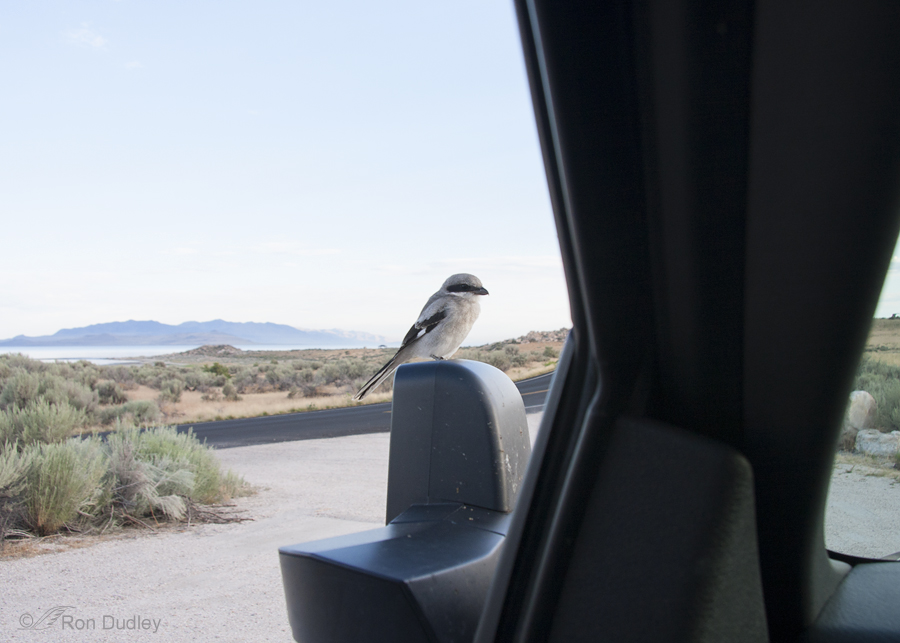
These young birds loved clamoring around on the hood of my pickup. They would look at their reflections, pick at smashed bugs and just generally act like inquisitive kids. It wasn’t unusual to hear a bird clicking about on my roof at the same time one of its siblings was on my hood.

Continue reading

Western Grebe Mated With Clark’s Grebe

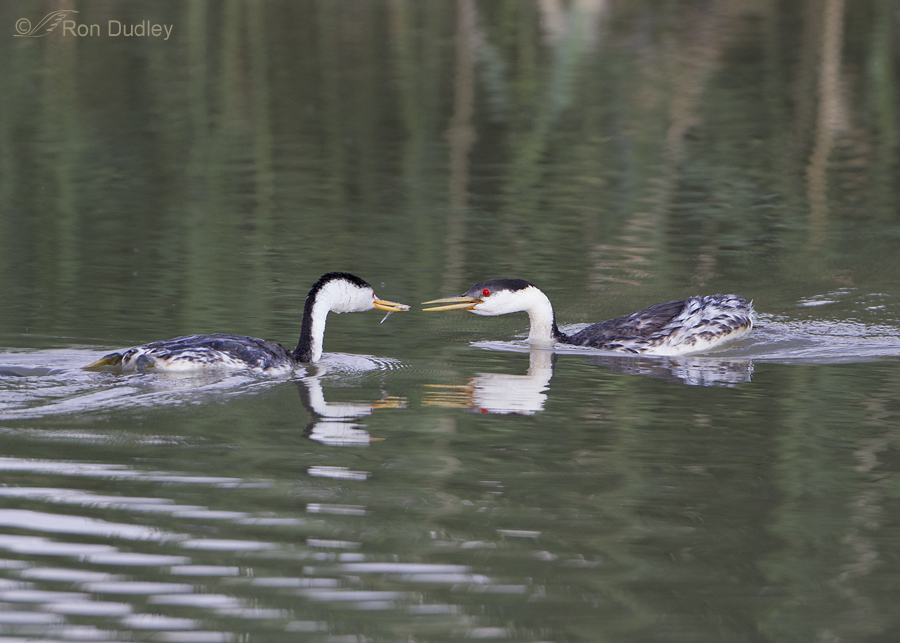
In the years I’ve watched and photographed the behaviors of both species I’ve never before seen a Western Grebe mated to a Clark’s Grebe. Mixed species pairs are uncommon to rare so to have seen this natural but unusual behavior was pretty special for me.

Continue reading

How Can This Hawk Even Fly?

This might just be the rattiest looking raptor I’ve ever encountered in the wild.

I found this juvenile Red-tailed Hawk three days ago in Box Elder County, Utah. It was too far away for good photos but even so I scoped it out with my lens for ID and to look for anything unusual.

Continue reading

Mucus-drinking Cowbird

Before Europeans came to North America and cleared forests which modified the environment into the agricultural and suburban landscapes of today, the range of the Brown-headed Cowbird was limited to the short-grass plains where they followed the almost endless herds of American Bison as they fed on the insects stirred up by those wandering behemoths.  Early settlers so strongly associated them with bison that they were called “Buffalo Birds”. Today that relationship still exists wherever limited numbers of bison can still be found.  Antelope Island is one of those places. One of the many challenges facing the cowbird was obtaining enough moisture as it followed the bison herds over the hot, rolling plains.  In late summer several years ago I photographed a cowbird behavior that illustrated one of the ways they solved that problem.   I found this huge bull languishing in the broiling sun next to a boulder that it had been using as a scratching post.  A group of Brown-headed Cowbirds were in the vicinity but at first I wasn’t paying much attention to them.   Then this female (at frame bottom) flew in close…     and began flying at the nostrils of the bull.  Initially I was unsure about what she was doing but she did it repeatedly and eventually it became clear that she was…     drinking the mucus-laden secretions from the bison’s nostrils.  She would actually hover in place as she gobbled down the long, stringy strands of mucus. Not a pretty sight and perhaps a bit unsettling to our human sensibilities but what an incredibly adaptive behavior…

Continue reading

Short-eared Owl Tattoo – A Work In Progress

Something a little different from me this time… In the past I’ve had a wide variety of requests for use of my images, including such disparate projects as prints, magazine and book publications, non-profit scientific and educational organizations (which I nearly always allow without a fee), fancy rubber stamps, uses by painters and other artists as subjects for their work, an image to be lacquered into the top of the communal dining table of a  new fire station in Temecula, California and several of my Northern Harrier (a type of hawk) images have been used in the AV8B Harrier (jump-jet) pilot training software at the Naval Air Weapons Station at China Lake, California. But a few weeks ago I got something new for me – a request to use one of my avian images for a very large, “photo – realistic” tattoo.   Jenna, from New Zealand, contacted me and requested to use this image of a female Short-eared Owl in flight (with brood patch visible on the belly) as the basis for the tattoo.  Her tattoo artist, Matt Jordan of Ship Shape Tattoo, Orewa, New Zealand, needed a high-resolution version of the image in order to get enough detail to make the very large tattoo photo-realistic.  Even though this shot was taken in extremely low light and doesn’t have quite as much detail as most of my photos, in the end there was enough. Matt Jordan is apparently very talented and in high demand so it took Jenna several months to get the project started.  It’s a long, drawn out and painful process.     Jenna’s first session with Matt lasted for 6…

Continue reading

Juvenile Burrowing Owl Parallaxing

Parallax is the effect where the position or direction of an object appears to differ when viewed from different positions.  When an observer moves, the apparent relative motion of several stationary objects against a background gives hints about their relative distance which the brain can interpret to provide absolute depth information. As you can imagine this can be very helpful to birds for flight and for judging prey position.  The movement required comes automatically during flight but it can also be provided while perched by exaggerated movements of the head in all three dimensions.  Tipping the head also provides cues by changing the relative position of the eyes to the object being viewed. Learning to interpret this information takes practice so many juvenile birds do just that, owls in particular. Techs for the following images – most were taken at 1/640 or 1/800, f/9, ISO 400, 500 f/4, 1.4 tc, natural light, not baited, set up or called in.  All images presented in the order they were taken.    Several years ago I spent a lot of time over several weeks photographing a family of Burrowing Owls along the causeway to Antelope Island.  Their burrow was very close to the road and they became almost completely acclimated to traffic so I was able to observe and photograph many interesting behaviors of both juveniles and adults from my pickup. Here, this juvenile is simply ignoring me (for the sake of convenience I’ll refer to this bird as a male though I have no idea what sex it…

Continue reading

Nothing Wrong With A Butt Shot Now And Again…

This isn’t the sharpest image in my portfolio but it does intrigue me.  A lot. Six days ago this Barn Owl made an unsuccessful plunge into the deep snow for a vole and soon after took off almost directly away from me.  This is one of the images I got as it lifted off in the direction of its favorite hill-top perch – a “butt shot” to be sure but I’m fascinated by the wing angle and position.    1/3200, f/7.1, ISO 500, 500 f/4, 1.4 tc, natural light, not baited, set up or called in This shot caught the wings toward the end of the upstroke.  The primary feathers at the end of the wings are in what appears to be an almost perfectly vertical position to allow for very little air resistance as they move to a higher position in preparation for the powered downstroke but the secondary feathers are pointed almost directly back at me. The skeletal structure of a bird’s wing is homologous (similar in position, structure, and evolutionary origin but not necessarily in function) to the forelimb of most other vertebrates (including humans) with a humerus, then radius and ulna, then metacarpals and finally phalanges at the end.  Like humans, the joint between the radius/ulna and the metacarpals is the carpal or “wrist” joint (see here if you’re curious and/or confused by the anatomy).   So the “wrist” is the joint between the primary and secondary wing feathers. Our wrist or carpal joint can be “bent” up or down and left or right but it cannot be rotated (try holding your…

Continue reading

Does Anyone Know What’s Wrong With The Eye Of This Northern Harrier?

It’s very cold here in northern Utah (8 degrees F. as I type) and there’s lots of snow on the ground – ideal conditions for photographing hunting Northern Harriers.  And yesterday morning everything was covered with a thick layer of hoar-frost which turned the marshes into a frosty fairyland.   I was able to get lots of shots of this particular bird and in the field I didn’t even notice that there was anything unusual about it.  Most of the images were flight shots and there just isn’t time pay attention to detail when you’re concentrating so hard on keeping the bird in the frame and in focus.     But when I got home and started reviewing my images I was taken aback.  Something’s definitely going on with the right eye of this bird.  At first I thought it might be just the closed nictitating membrane but I have dozens of shots of this bird and the eye is the same in all of them.  It’s definitely not a normal membrane, if it’s the membrane at all.     A better look at the right eye.     This is probably the sharpest, most detailed image I was able to get of the bird.     An extreme crop of the previous image to show the best detail I could manage.  To my untrained eye it looks like there may be some kind of fungal growth in and around the eye that may have discolored the eye ring and nictitating membrane and closed the membrane permanently, but that’s only a guess….

Continue reading

Rough-legged Hawk “Playing”

This post is about behavior.  Please don’t expect high quality images… Last March I found this juvenile (I believe) Rough-legged Hawk along the Antelope Island causeway on a cold morning after a light snowfall.  It was perched on a windrow of debris consisting mostly of piles of old brine fly pupae casings.   For a while the bird seemed content to simply rest and watch me.   But soon it apparently got bored…     and walked about two feet to my right to investigate a clump of fly casings (red arrow) that had been cemented together by melting snow that had re-frozen during the night.     The hawk reached over to grasp the clump with its talons…     retrieved the clump,…     transferred it to its beak and then instantly tossed it to the ground.  I assumed that was that, figuring the bird had thought it might be something edible, then discarded it for good when it wasn’t.  But that wasn’t what happened.     The hawk grabbed the clump with its talons once again…     and then seemed to contemplate for a few seconds about just what to do next.     Which turned out to be something like “give the clump a toss and see where it lands”.     The hawk immediately started walking over to where the clump had landed behind the mound of fly casings, where it can’t be seen in this image.  It used its wings for a little more stability as it negotiated the hill of debris.  …

Continue reading