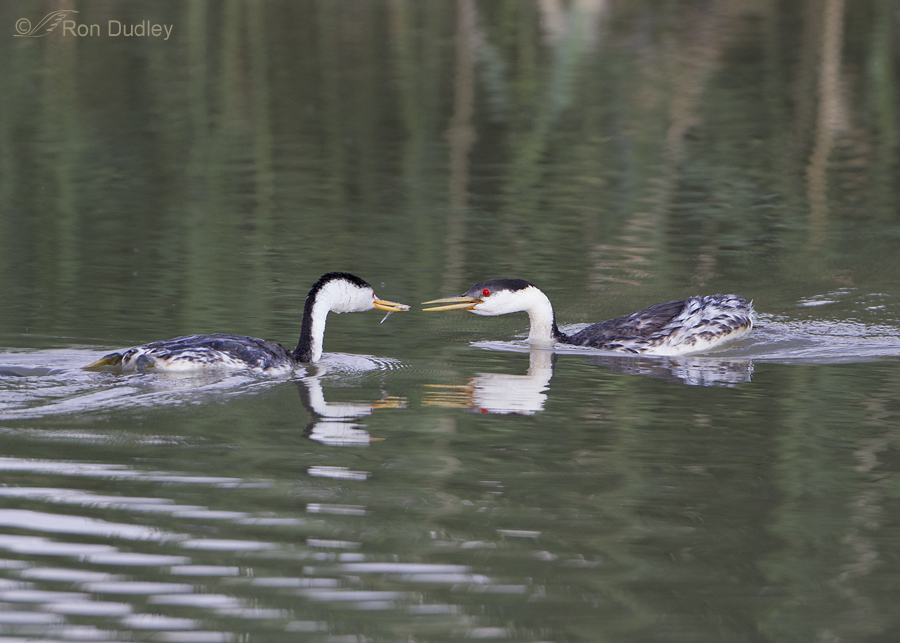
Western Grebe Mated With Clark’s Grebe

In the years I’ve watched and photographed the behaviors of both species I’ve never before seen a Western Grebe mated to a Clark’s Grebe. Mixed species pairs are uncommon to rare so to have seen this natural but unusual behavior was pretty special for me.
Continue reading

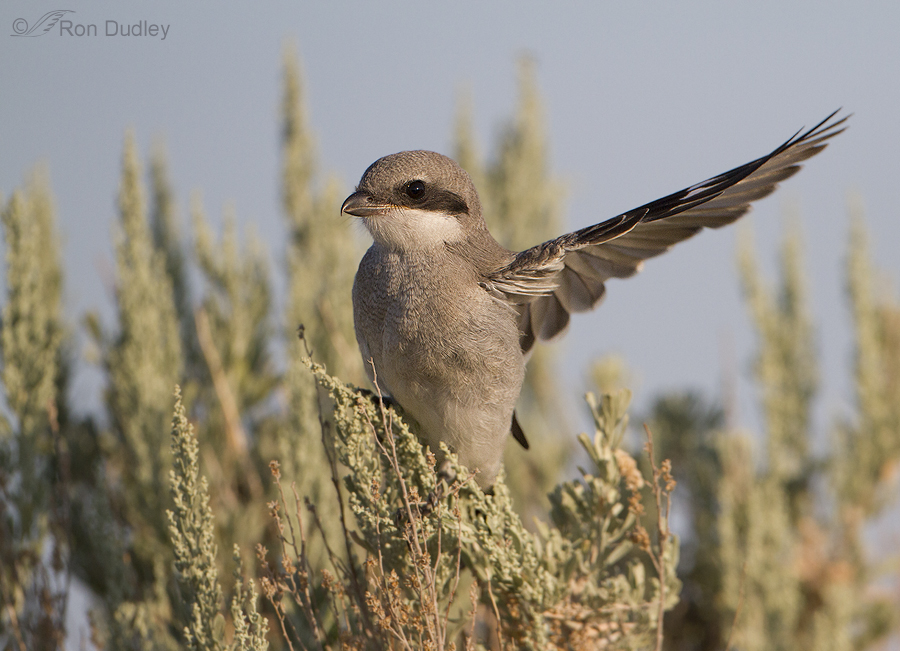
Fledgling Loggerhead Shrike Begging For Food

I photographed a family of very cooperative Loggerhead Shrikes last week on Antelope Island. The young birds had already fledged and were very actively exploring their world, strengthening their wing muscles by flying from perch to perch and testing a variety of objects for their potential food value.

And they were gutsy! Several times a juvenile landed on the tailgate of my pickup as you can see here.

Continue reading

American Kestrel With Snake Prey

Anyone who follows my blog knows that I observe and photograph kestrels often but I’ve never before seen one with snake prey. In my experience it’s always been voles, mice, small birds or (less often) insects. When we first noticed this bird it already had the snake on this bush perch.

Continue reading

Rough-legged Hawk With A Peculiar Hunting Technique

I’ve spent many hours watching Rough-legged Hawks hunt.  Nearly always they hunt from the air or from elevated perches but several years ago this bird showed me a technique I had never seen before and haven’t since. All of these images are presented in the order they were taken. Techs for these shots were: 1/2000 – 1/3200, f/8. ISO 400, 500 f/4, 1.4 tc, natural light, not baited, set up or called in   I found the hawk on the ground and as I approached it in my pickup it didn’t fly off as I expected it would.  Here it’s looking at me but most of the time it was scanning the grasses in the vicinity – obviously hunting for voles from the ground.     It would lift off but only fly a few feet before it landed again.     In this first lift-off it had vegetation in its talons.  I’ve seen them do this before – it’s almost like they’re reluctant to let go of the plant material after they’ve missed the prey.     The hawk landed again…     And intensely scanned the surrounding area for prey.     Then another take-off…     and it flew within inches of the ground…     before it pounced on a vole and swallowed it.     Then it continued to hunt in the same manner.       Another take-off…     and another.  There’s blood on the right foot from the last vole.     The hawk repeatedly did the same thing – take…

Continue reading

Mucus-drinking Cowbird

Before Europeans came to North America and cleared forests which modified the environment into the agricultural and suburban landscapes of today, the range of the Brown-headed Cowbird was limited to the short-grass plains where they followed the almost endless herds of American Bison as they fed on the insects stirred up by those wandering behemoths.  Early settlers so strongly associated them with bison that they were called “Buffalo Birds”. Today that relationship still exists wherever limited numbers of bison can still be found.  Antelope Island is one of those places. One of the many challenges facing the cowbird was obtaining enough moisture as it followed the bison herds over the hot, rolling plains.  In late summer several years ago I photographed a cowbird behavior that illustrated one of the ways they solved that problem.   I found this huge bull languishing in the broiling sun next to a boulder that it had been using as a scratching post.  A group of Brown-headed Cowbirds were in the vicinity but at first I wasn’t paying much attention to them.   Then this female (at frame bottom) flew in close…     and began flying at the nostrils of the bull.  Initially I was unsure about what she was doing but she did it repeatedly and eventually it became clear that she was…     drinking the mucus-laden secretions from the bison’s nostrils.  She would actually hover in place as she gobbled down the long, stringy strands of mucus. Not a pretty sight and perhaps a bit unsettling to our human sensibilities but what an incredibly adaptive behavior…

Continue reading

A Shrike Partially Consumes Its Own Pellet

This post is documentary only.  The images are not aesthetically pleasing. Loggerhead Shrikes produce a pellet from an insect meal only 35.5 minutes (on average) after consumption.  This is an amazingly fast turn-around time (Short-eared Owls average 8.5 hours before a pellet is produced from their rodent prey).   When shrikes are consuming insects and spiders their pellets consist of the indigestible chitinous exoskeletons of those arthropods. I’ve seen and photographed Loggerhead Shrikes ejecting pellets many times but what I photographed on this August morning was new to me.   Because of the cluttered setting I was mostly only watching this juvenile through my lens (not photographing it) when I could tell it was about to chuck up a pellet. Every time I’ve observed this behavior in the past the pellet was ejected quickly and cleanly and simply fell to the ground.  But this bird had a surprise for me.  It caught the pellet in the tip of its beak…     and manipulated it there for some time.     Then it very deliberately mashed up the pellet and appeared to be swallowing parts of it as other smaller pieces fell to the ground.     My guess would be that about half of the pellet was consumed as the other half fell away, though I can’t be absolutely certain that any of it was actually eaten because my view of what was happening was not always a clear one. I wish I knew what was really going on here.  This is the only time I’ve ever seen a bird (of any species) manipulate a pellet after…

Continue reading

Terns – After The Dive

Terns tend to be graceful and highly maneuverable flyers and those skills are very much on display when they’re fishing.    1/5000, f/6.3, ISO 500, 500 f/4, 1.4 tc, natural light I found this Forster’s Tern fishing at Bear River MBR last June and decided I’d attempt to photograph it coming out of the water after a dive – easier said than done.  And to catch it with a fish would be a bonus.  This species is known for feeding on “small” fish but this one is ridiculous – hardly worth the bother.  If you look very carefully you can see the miniscule fish behind the upper part of the bill.   I’ve cropped this shot unconventionally in order to include the “splash” behind the bird. These birds fish relentlessly.  Their quarry is small, as is their success rate.  In one Forster’s Tern study, 1538 dives produced 369 fish for a success rate of 24%.      1/5000, f/6.3, ISO 500, 500 f/4, 1.4 tc, natural light The fish is more easily seen in this next shot.  When they come off the surface they usually shake excess water out of their feathers in mid-air.  I caught this tern just before the shake, where it has twisted its wings in order to get good action for the upcoming shake.  I missed the shake with this bird but…      1/1250, f/6.3, ISO 500, 500 f/4, 1.4 tc, natural light I did manage to capture it on another day with this Caspian Tern.  I didn’t have enough shutter speed to get the quick movements particularly sharp but…

Continue reading

Western Grebe Fish Delivery

Temperatures are finally warming a bit here in northern Utah but the world is outside is still monotonously white.   Yesterday morning I measured 22 1/2″ of snow on the north end of Antelope Island, indicating that our bleak and largely featureless landscape will remain the same for the foreseeable future. So this morning I needed a break and decided to post an image (taken this past June at Bear River MBR) that would remind me that spring is somewhere out there on the distant horizon.    1/3200, f/7.1, ISO 640, 500 f/4, 1.4 tc, natural light Western Grebes are devoted parents to their incessantly hungry and noisy chicks.  The male and female take turns with their parental duties – one will back brood the youngsters while the other delivers fish and then they alternate responsibilities.  Here the female (smaller than the male, with a shorter, thinner bill – thus sexual dimorphism) has caught a small fish and is delivering it to the male.  Usually the parent receiving the fish will give it to the chick, as happened here. As I’m sure is obvious, I’m very much looking forward to watching and photographing springtime bird activities once again.  It’s going to be a very long 2-3 months… Ron

Continue reading

Loggerhead Shrike Attempting To Impale A Grasshopper

Shrikes are well-known for impaling their prey on sharp projections like thorns or barbed wire as a means of food storage – they’re called “butcher birds” for good reason.  I suspect the behavior to do so is innate but to become skilled at it takes practice. This past summer I found this Loggerhead Shrike on a fence on the Montana farm where I grew up.  It had already captured the grasshopper when I arrived on the scene. First, my standard disclaimer for behavioral sequences.  This bird was strongly sidelit so I seldom got a catch light and the light was harsh.  To compensate, I did more processing with these images than I normally do because my intent is to show the behavior as well as possible, even though image quality suffered from the processing.   Almost immediately I could see that the shrike was going to attempt to impale the grasshopper on the barb just below and in front of the beak of the bird.     Impaling prey apparently isn’t an easy task.     From all the contortions the bird went through…     I’d assume that part of the problem was the awkward angle the shrike was at…     to get proper leverage to complete the task.     At one point the bird nearly fell off the fence.     After a few moments the shrike gave up, turned its back on me with the grasshopper between its legs (and a gob of grasshopper on its bill) and seemed to contemplate what…

Continue reading

A Pied-billed Grebe Attempts To Dismember A Frog

Pied-billed Grebes are opportunistic feeders, taking large crustaceans (especially crayfish), fish, insects and other invertebrates.  They also consume a lot of frogs when they’re available.  When the prey is too large to swallow whole (frogs and crayfish especially) they grasp the appendages with their beak and shake it vigorously until the limbs break off.  I’ve also seen adults tear off bits of the body trunk of frogs to feed to their chicks.   This bird is a juvenile, still learning the finer points of consuming prey.  This stage of plumage development is referred to as the “stripe-head stage”, for obvious reasons.  Adults lose those stripes.  The frog it has captured is probably one of the first amphibians the bird has had to deal with without assistance from a parent and that inexperience seemed obvious as the young bird dealt with the frog. I’ve presented all the photos in this series in the order they were taken.     As you can see, the young frog hasn’t yet fully metamorphosed into an adult and retains the tadpole tail.     The grebe would repeatedly grasp a limb (it tried all 5 of them several times)…     and then shake the frog violently in an apparent attempt to tear the appendage off like it has seen its parents do so many times before.     Here it’s working on the left front leg.     Other times the bird would grasp the body and shake.  Hard!     At times the grebe would appear to rest and “think” about its…

Continue reading

Northern Harriers Hunting

It’s getting to be what I call “harrier time” here in northern Utah so I thought I’d do a significant post on the species.  For me, watching these birds hunt is absolutely mesmerizing and I could do it for hours.  And I have – many, many times. But before I get into hunting I’d like to cover some basics on telling the sexes and ages apart.  Sexual dimorphism in harriers is exceptional among birds of prey – telling adult males from adult females is easy because their colors are so dramatically different.  But because juveniles of either sex strongly resemble adult females, that distinction becomes very tricky and causes a lot of confusion.  So, here’s a primer: Adult males – gray above, mostly white below, black wing tips, lemon-yellow eyes Adult females – brown above, buffy with  brown streaks below, lemon-yellow eyes (but in my experience, the eyes of adult females tend to be less bright than those of adult males) Juvenile of both sexes – similar to adult female but darker chocolate-brown above and strongly rufous (reddish) below Juvenile male – pale, greenish-yellow eyes Juvenile female – dark, chocolate-brown eyes   All sexes and ages have the unique facial disc (ruff) characteristic of harriers.   It’s not as prominent as it is in many owls but it can clearly be seen in this image.  Its function is the same as it is in owls – to direct sound to the ears.  Most hawks hunt almost exclusively by sight but because of their excellent hearing, thanks largely to the facial disc, harriers depend at least…

Continue reading