

There’s a reason why I’ve posted so few photos of Ruddy Ducks to Feathered Photography over the years – they seldom let me get close enough for decent photos. But over the last few days a pair of ruddys has let their guard down twice, briefly, and came in reasonably close to me. The photos below are some of the results.
Ruddy Ducks are legal to hunt but hunters have little interest in them because they’re so small, they’re perceived as not tasting good and when approached they have a strong tendency to dive instead of flying. Ruddy Ducks are introduced and invasive in western Europe, where populations are culled to limit hybridization with the endangered White-headed Duck.
But in North America birders appreciate Ruddy Ducks for the rich colors and striking sky-blue bill of adult males and the highly entertaining courtship displays of breeding pairs.
And for me personally, a photographer who loves to photograph interesting bird behaviors, Ruddy Ducks have another attraction. Despite their small size they’re considered to be “the most pugnacious of waterfowl”. They’re even known to chase rabbits feeding along the shoreline.
A tiny duck chasing a rabbit is something I’d like to see. And photograph.
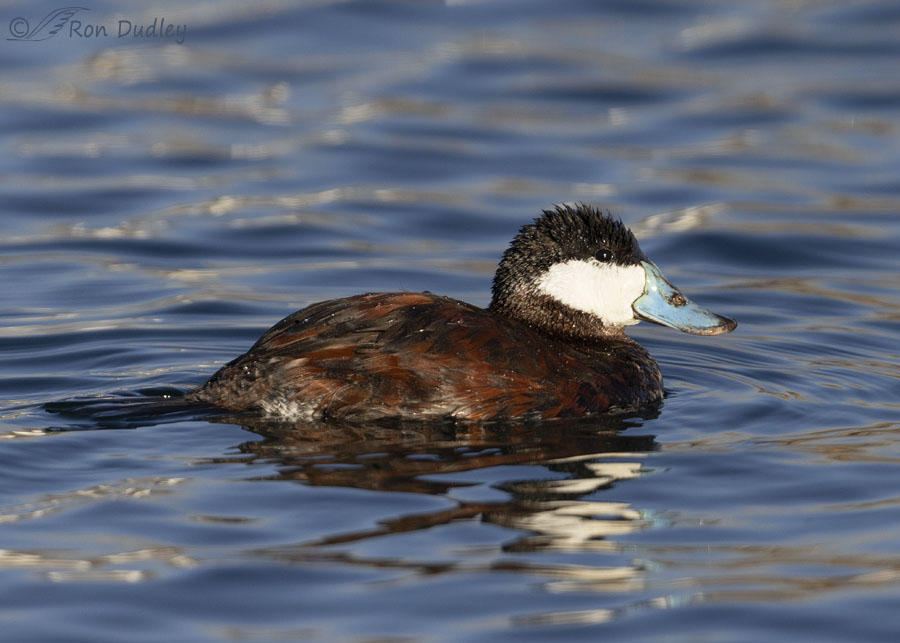
This is the male of the pair I’ve been trying to photograph. During the non-breeding season male bill color is gray-black but this guy’s bill has already turned mostly blue.
On those rare occasions when I do photograph male ruddys up close their dark eyes usually almost disappear in the blacks of the tops of their heads so I was happy to get a distinct eye, with catchlight, in this photo.
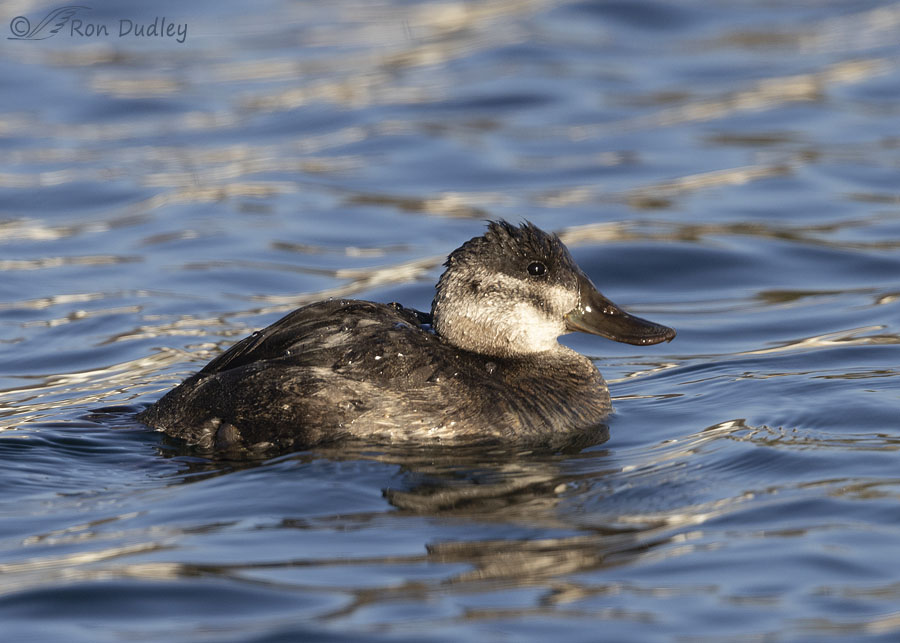
Here’s his mate. Ruddy Ducks usually don’t pair up and bond until a little later in the year but these two were almost joined at the hip. Where the male went the female nearly always followed but sometimes it was vice versa.
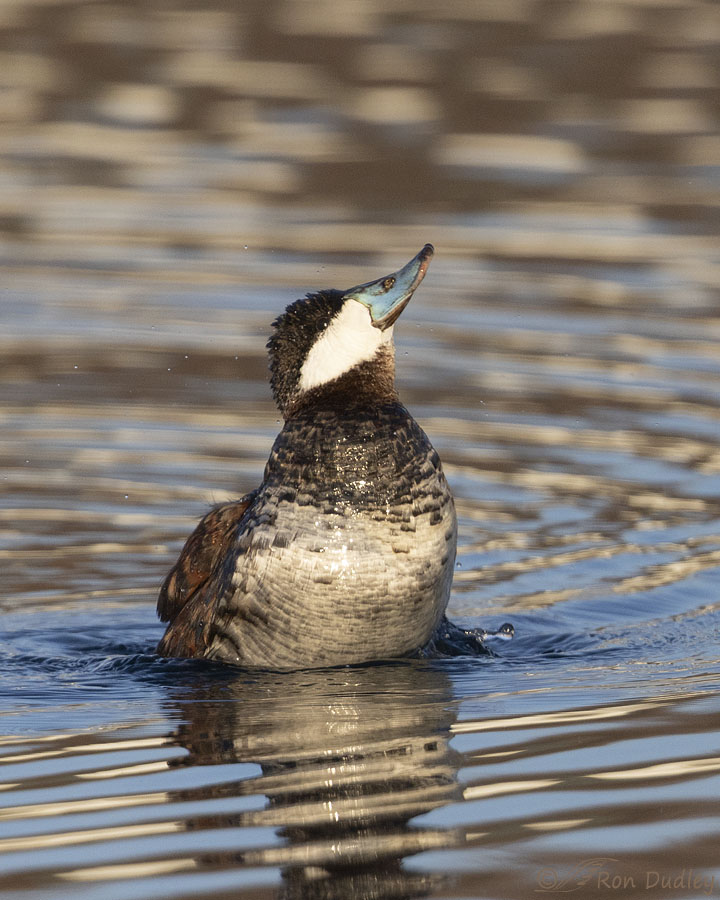
Here’s a look at some of the male’s ventral plumage that is usually hidden in the water.
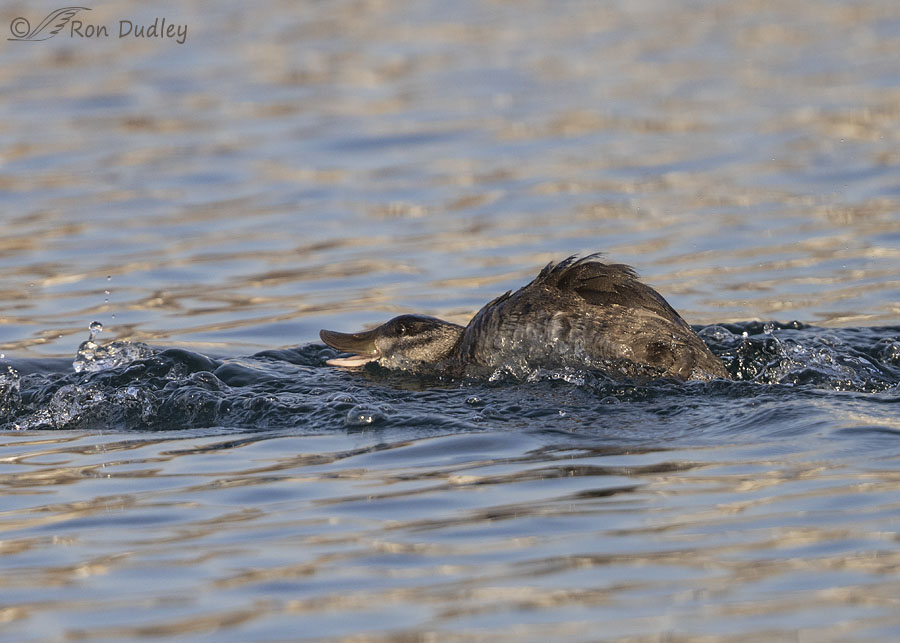
Ruddy Ducks are most aggressive when they’re actively breeding but while I was with them the female demonstrated that aggression isn’t limited to the breeding season, or to the males. While I had my lens on her she suddenly began chasing another bird across the water. I got many photos of her skittering across the water and in most of them her bill was open in apparent anger.

I didn’t know what she was chasing until this shot that included the recipient of her aggression – a Pied-billed Grebe making its getaway. The photo needs clockwise rotation but if I applied it I’d lose most of the female ruddy at the right edge of the photo. As it is I only have her head.
I wish the grebe had its head turned toward me because I like that big bubble.
These may not be great photos but for me some of them are pretty darn good, considering that they’re of Ruddy Ducks. Our ponds still haven’t frozen up so maybe they’ll stick around for a while.
Ron
Note: In 1926 J.C. Phillips, an American hunter, zoologist, ornithologist and environmentalist, had this to say about the Ruddy Duck.
“Its intimate habits, its stupidity, its curious nesting customs and ludicrous courtship performance place it in a niche by itself. Even its eggs are unique in appearance and are deposited in a slip-shod, irregular manner that is most extraordinary. Everything about this bird is interesting to the naturalist, but almost nothing about it is interesting to the sportsman.“
A very belated expression of appreciation for these great photos! I did not know the ruddies are most aggressive! Thanks also for sharing the shot of ventral feathers!
What an exciting post, Ron! What nifty behaviors by all your subjects!
And now for the first thought that popped into my head when I read the title: drakeruddyduckdrakeruddyduckdrakeruddyduck 🤪😂
Thanks, Marty. Like me, sometimes your mind takes you to strange places.
What a great post today! It’s wonderful this pair decided to show off for you. The colors in the males feathers are beautiful, and his ventrum looks like a Byzantine mosaic. Gorgeous! That grebe was very sensible, scooting off – Mrs Ruddy sure doesn’t look like someone to tangle with 🤣
Thanks very much, Carolyn. I like your comparison to a Byzantine mosaic.
Ron,
“Pugnacious!” I had to look that one up. I always learn something!
Stephen, originally I used both “pugnacious” and “aggressive in that sentence. But soon after I published I removed “aggressive” for fear of being redundant, or nearly so.
NEAT! Great captures of both the ducks and the aggressive tendencies! 🙂 White Headed Duck is a bit weird looking with it’s massive upper bill at the base…… 😉
Thanks, Judy. I’m glad you followed the link to the White-headed Duck. I think they’re pretty neat looking.
Your comment about never seeing these fly reminded me of the one time I saw a Pied-billed Grebe take to the air. It was as astonishing as it was unexpected. I grinned at the aggressiveness, too. It reminds me of our Coots, which can provide hours of entertainment, both in and out of breeding season.
That quotation at the end is hilarious. I listen to a radio call-in show here for hunters and fishermen, and listening them talk about some of my favorite birds is often as funny as it is instructive.
Shoreacres, for a couple of reasons I sometimes follow various hunter sites online. Many of the things I see them say make me cringe.
Duck, duck, rabbit! 😆
Have never seen a Ruddy Duck or an Andean Duck. Someday!
Get ready for some serious traveling, Kathleen. You’d have to travel at least as far as Columbia to see an Andean Duck in the wild.
Thanks for this mornings photographs, and for the insight into the ways of the Ruddy Ducks. That quote from J.C. Phillips is a gem.
I’m glad you appreciated the quote, Michael. I added it as an afterthought, one that I thought was… interesting.
Your post today was so full of info totally new to me ! I’m glad you
got a chance at a scarce photo subject, and I hope some day you’ll
be able to post a photo of a “duck chasing a rabbit”– it’s interesting
to me how often the tiny– of many species– is proactively aggressive to much larger critters– I think of it as the chihuahua effect…..
“I think of it as the chihuahua effect…..”
Kris, some call it Napoleon Syndrome. Knowing chihuahuas, both work for me.
Wonderful series, Ron. Never underestimate the tenacity of the female Ruddy! In all my years of birding, I can’t ever recall having seen them in flight. Thanks for sharing this morning!
Diane, I’ve not seen them fly either. Not once that I can remember.
Yes, I also enjoy pictures and stories! Mary
Thanks for both comments, Mary.
Wonderful to see! Thank you!
Nice! Looking forward to you getting a shot of one chasing a rabbit! Wonder why Phillips deemed the species ‘stupid?’ I enjoyed seeing them in Tucson.
“Wonder why Phillips deemed the species ‘stupid?”
I wondered the same thing, Burrdoo. Maybe stupid is as stupid does… 🙂
Nice story Ron. We also have a Ruddy Duck in Chile: Malvasía Andina (Oxyura ferruginea), It may be a relative of the northern one you shared in your post.
Ricardo, your comment piqued my interest so I looked it up. Here’s what Cornell has to say about your “Ruddy Duck” – common name Andean Duck.
“Andean Duck is the South American counterpart to Ruddy Duck (Oxyura jamaicensis) of North America. Currently Andean Duck and Ruddy Duck are completely allopatric, but the northernmost populations of Andean Duck, in the Central and Eastern Andes of Colombia, are somewhat intermediate between the two species, suggesting introgression between them at some time in the past. Andean Duck is larger than Ruddy Duck; male Andean Duck has an entirely black head, lacking the bold white cheek patch of Ruddy Duck, and female Andean Duck is much darker than female Ruddy Duck. The biology of Andean Duck is very poorly known, although it probably is generally similar to that of Ruddy Duck.”
I enjoyed the pictures and the information.
Good. Thanks, Laurie.