

Last week I spent parts of four mornings with what I believe to be the same Spotted Towhee. Each time I arrived at the same clump of bushes just before sunrise, only to find that ‘he’ wasn’t there. But each time, within a few minutes to half an hour, he’d show up.
Following is a collection of photos from all four mornings.
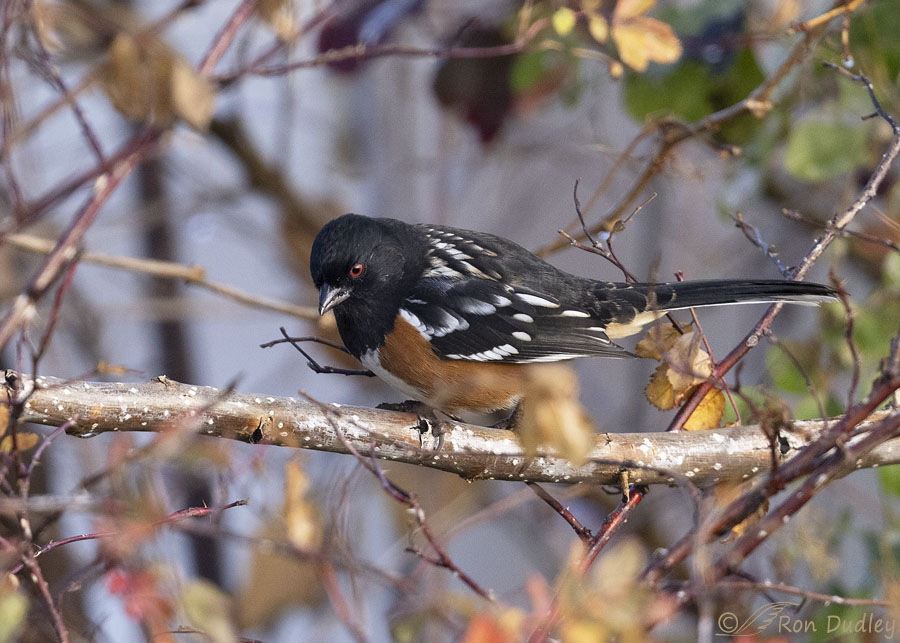
I never knew from where he came but he always first appeared fairly high up in the bushes, which in my experience is unusual for Spotted Towhees. Usually I see them on the ground, foraging for food.
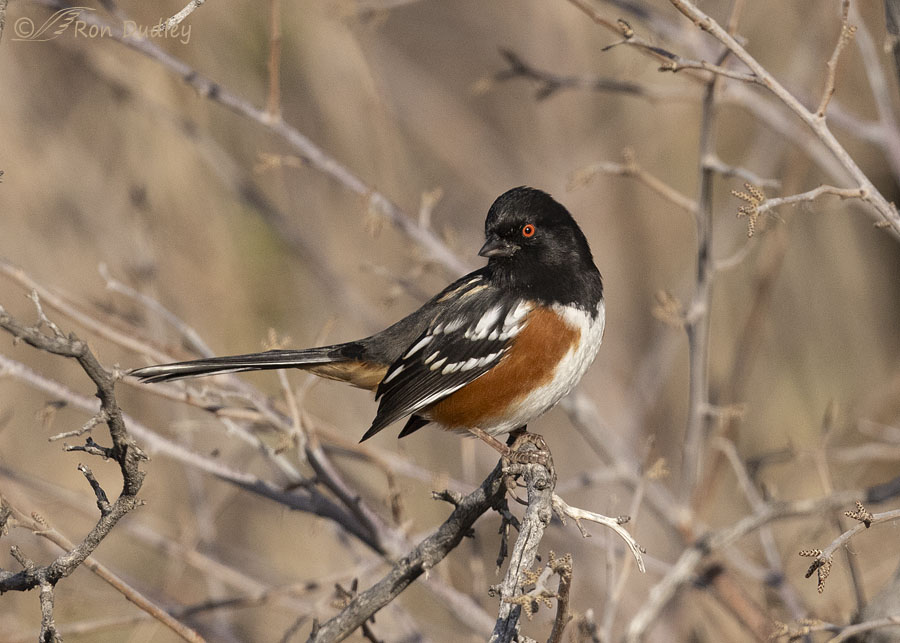
This time he was so far off the ground I made a mental note of how far. My estimation was that it was about 7′.
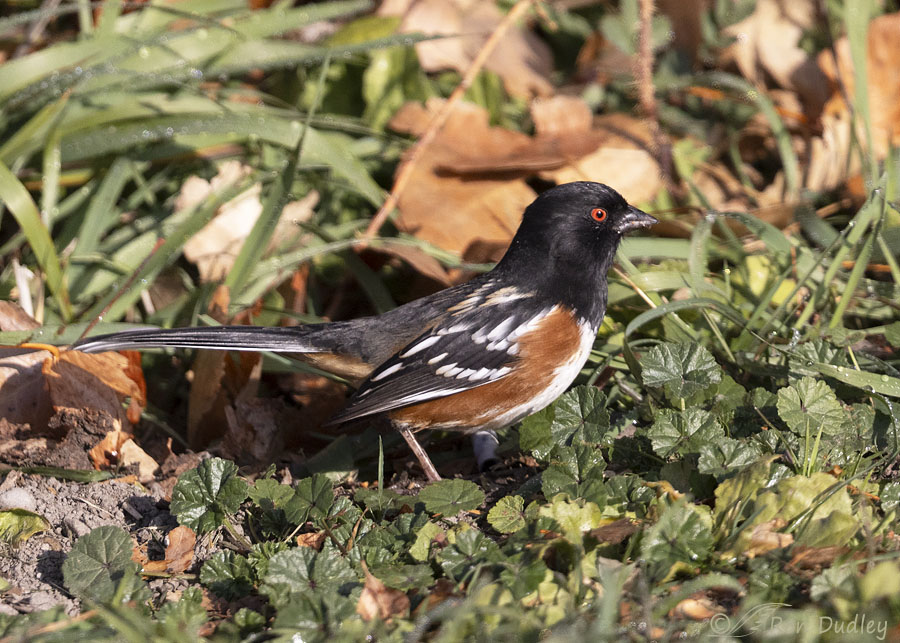
But he always ended up foraging for food on the ground, in the mix of green vegetation and dead leaves right in front of the dense thicket of bushes.
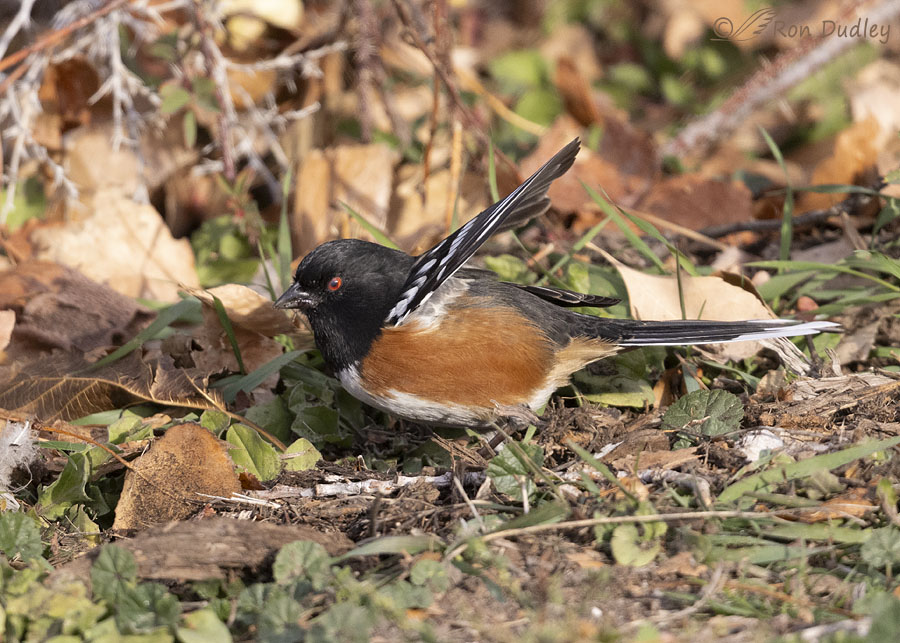
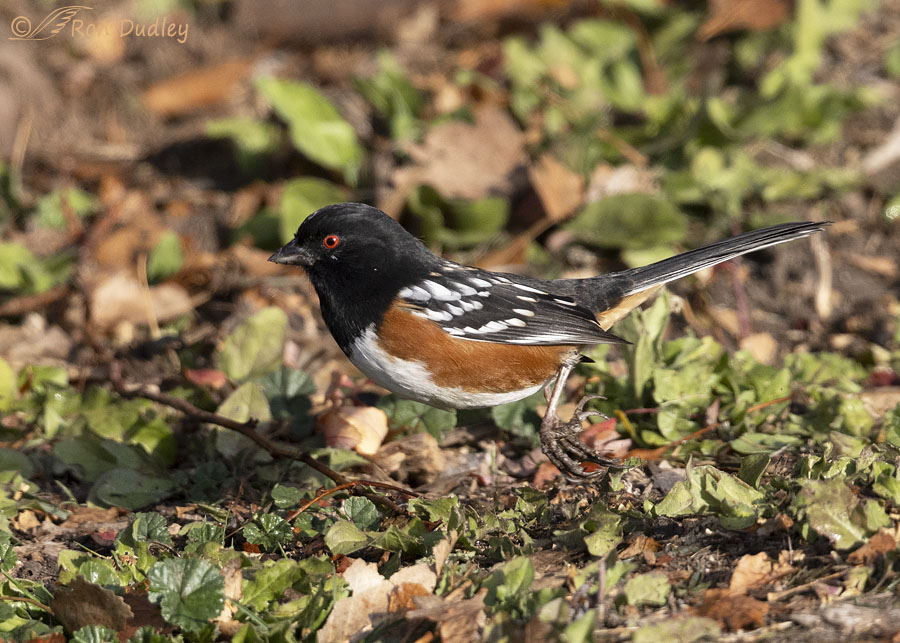
As he searched for specific spots to forage he was twitchy and fast. He often flicked one of his wings as he was doing so. His eye looks a little funky because his nictitating membrane was at least partially closed.
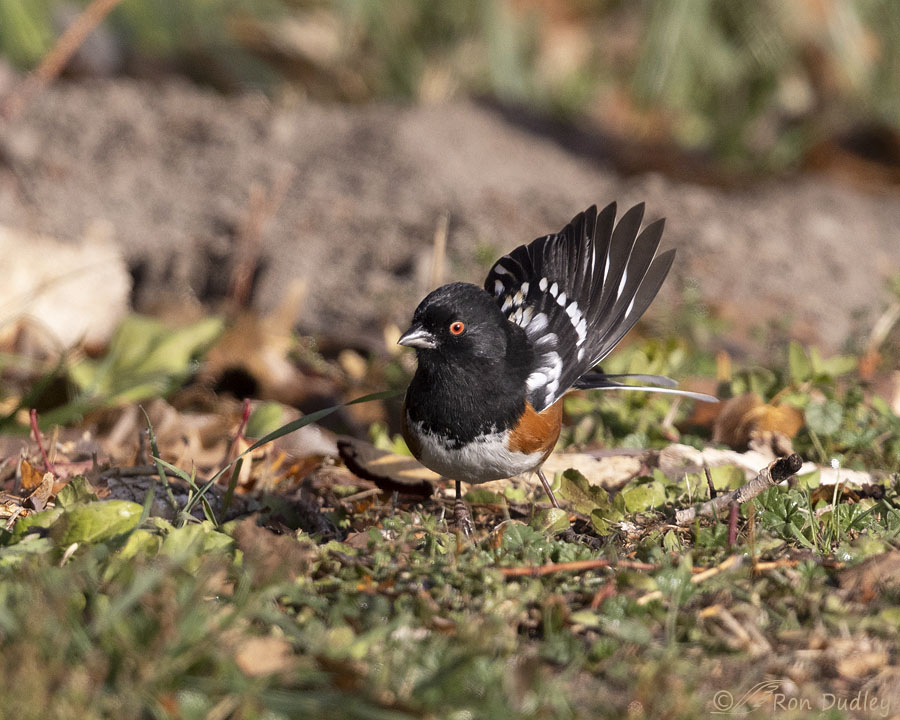
I didn’t notice it until I was processing these photos but it was always his…
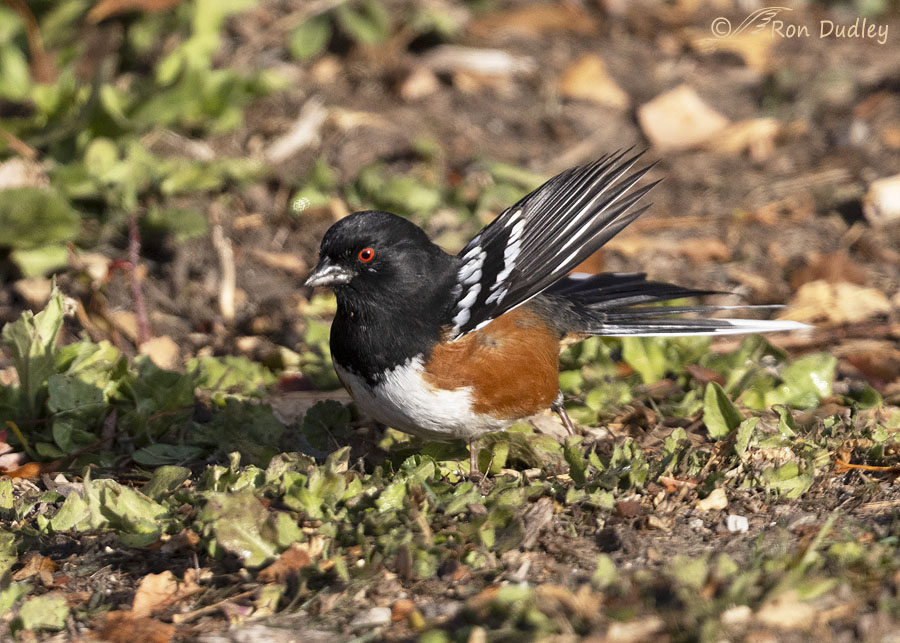
left wing that he flicked. I doubt it was because he is sinistral (left-handed), but you never know. Some birds are known to exhibit handedness.
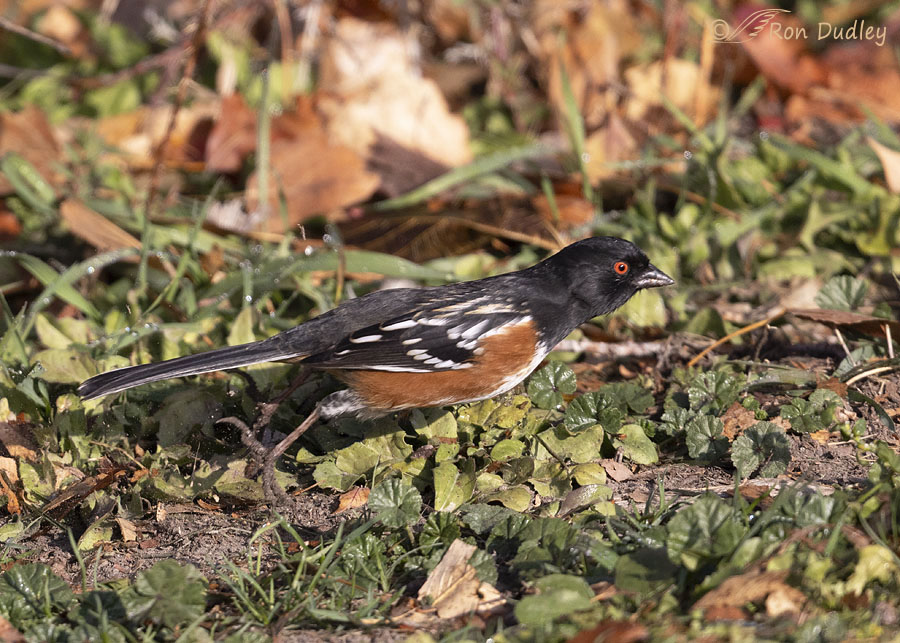
This was the only time I caught him jumping to a new foraging spot.
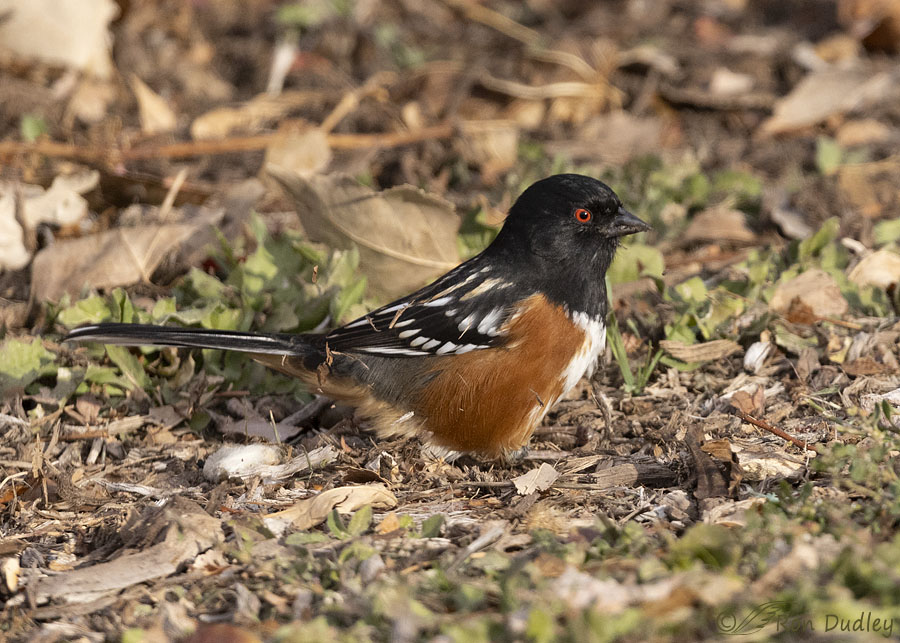
In this shot it looks like he’s holding still and maybe he was for a microsecond or so. But look closely. There’s flying debris in front of and just below the base of his tail because he’d been scratching for food.
Spotted Towhees typically use “bilateral scratching” to uncover food, meaning they scratch backwards with both feet at the same time.
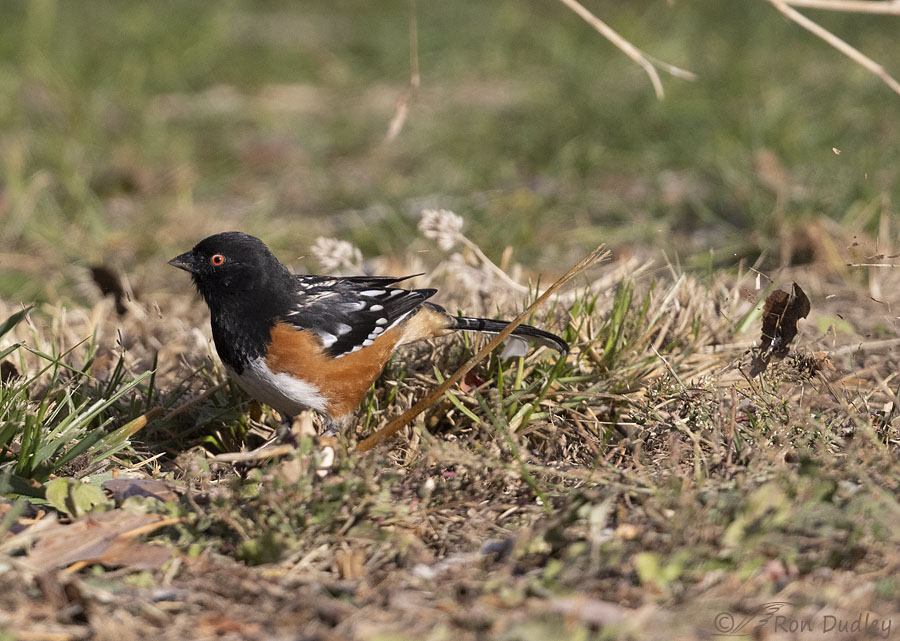
Their bilateral scratching often sends lots of debris flying behind them. Here we see a dark, dead leaf and other debris flying behind him.
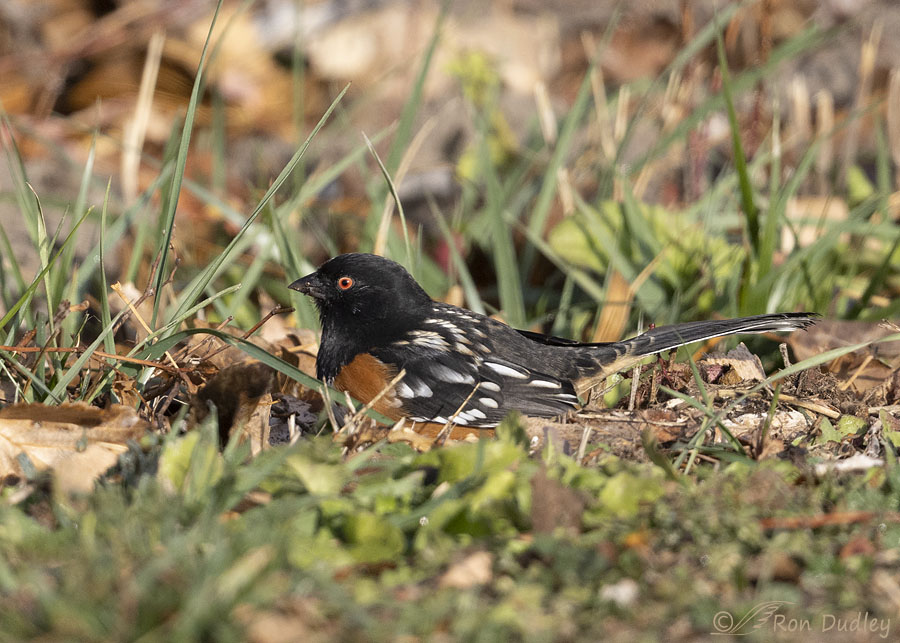
Occasionally he’d scratch in the same spot for long enough to dig a hole that he started to disappear in. Sometimes I could only see the top of him in one of the holes.
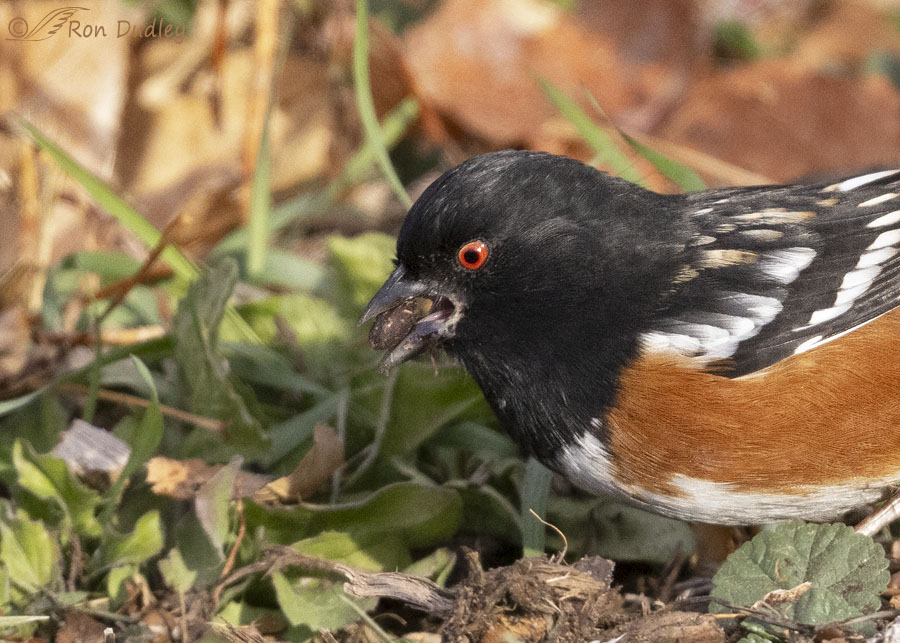
This photo is a little soft but it was the only time I could see what he was eating.
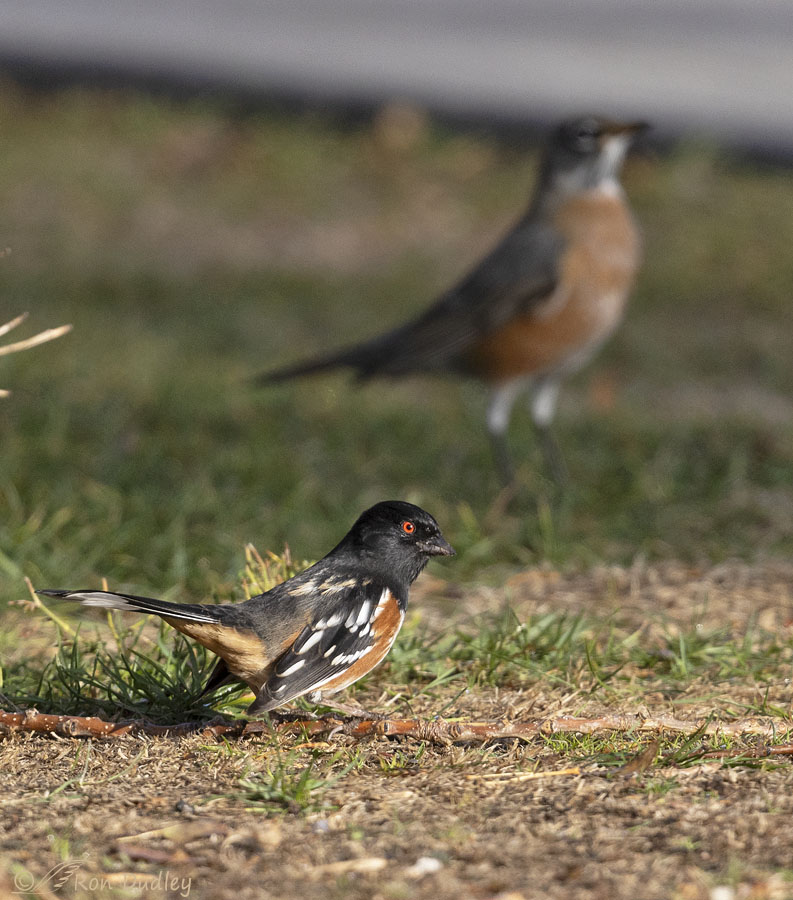
His frenetic feeding activity often attracted the attention of other birds, including robins and three species of sparrows (House, Song and White-crowned). Here we see the towhee and a robin eyeballing each other.
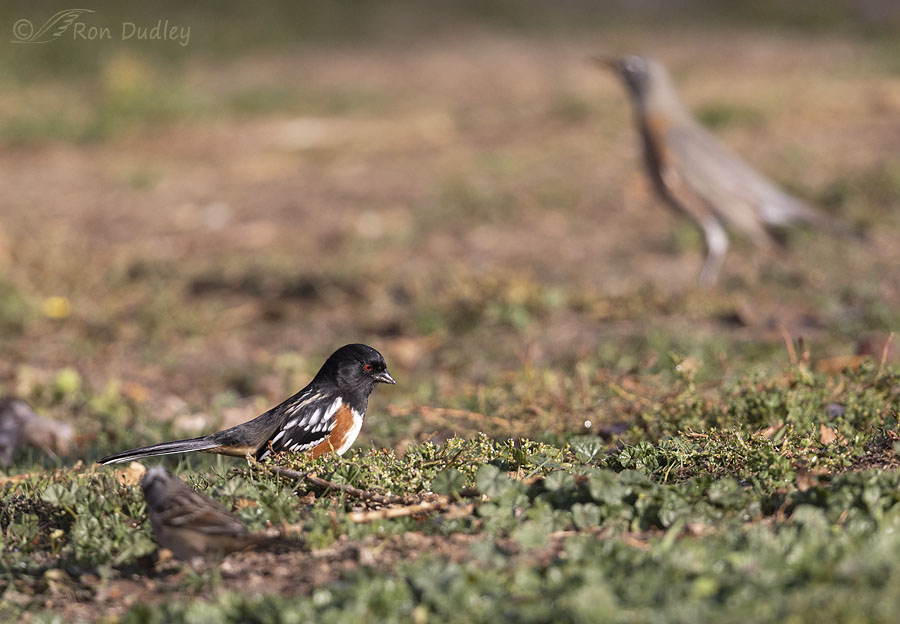
Here he’s caught in the middle between a nosy robin at upper right and a White-crowned Sparrow at lower left.
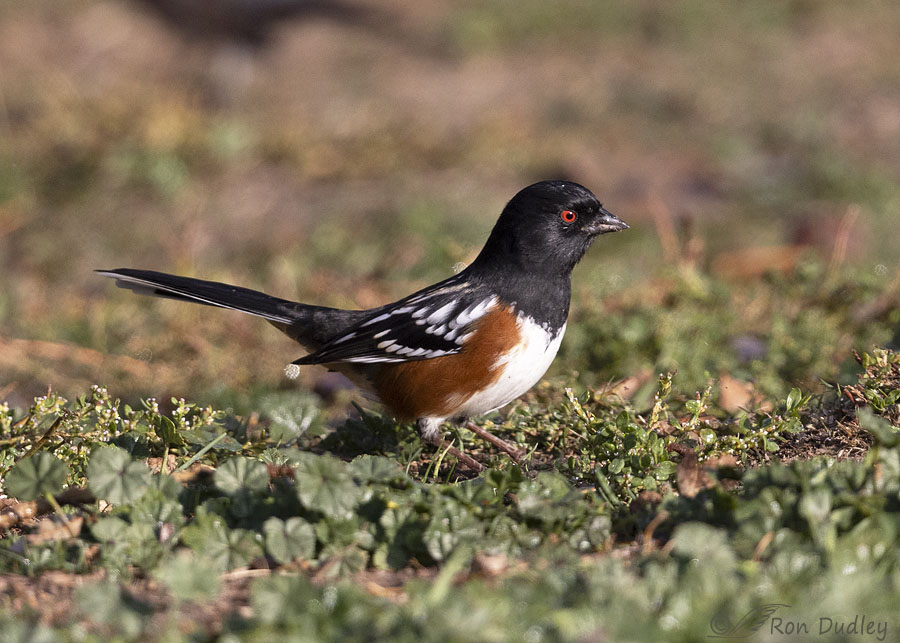
This was one of my favorite photos of him, in part because it was the closest he ever got to me.
In those four days I took several thousand photos of him but many of them were quite similar. For today’s post I attempted to give my readers as much variety in poses and behavior as I could.
Ron
Notes:
On three occasions a second towhee showed up but the two birds never got along so one of them always chased the other one off. I mention this because it’s possible that one or more of these photos is of the second towhee. When there was two of them it was very hard to keep track of which bird was which.
I believe both towhees have now moved on. I haven’t seen either one on my last two trips to the clump of bushes.
Absolutely gorgeous bird and beautiful photos as well! Thank you for sharing and for observing so carefully!
I always enjoy a series that you put together. Your accompanying commentary makes it so enjoyable, and the Towhee photos are a great example. Learned something today before I finished my coffee! That’s a great start!! Thanks for sharing those photos.
Good story line to go along with great pictures. He is a BEAUTIFUL bird – one that I have never seen – so THANKS!
This is a wonderful substitute for the towhees that occasionally show up scratching under the junipers in my yard. They are such gorgeous birds, a lovely contrast to the usual resident house sparrows. I love it when they deign to visit, and it is always a treat to watch them doing that jump/scratch – now, with your photos, I can actually see what they are doing! Thank you!
Thank you, Carolyn.
Do you think the towhee was flicking a wing to scare up bugs? Lots of other birds with spots on their wings do that.
Pam, I never thought about that possibility. Could be, although Spotted Towhees eat mostly plant material in winter.
Interesting info and beautiful photos, Ron. These guys are pretty common in some of the foothills areas above Fort Collins, but I haven’t been in the right places lately to see and hear them. I’ll have to remind myself to do that.
“I’ll have to remind myself to do that.”
Bill, in case you forget, here’s another reminder! Thanks.
Hi Bill,
Fellow Ft Collins-er here. I see them quite often in areas of Lory (Overlook Trail mostly) but never anywhere that offers much for photography opportunities. Curious if you know of other locations I should be looking? Thanks!
“Twitchy and fast”… Just like a Spotted Towhee. One more reason to leave the leaves. I love hearing about how deep the bilateral scratching got him. And I’m curious what the other two sparrows were.
Always happy to see email from you, Ron. Thanks!
“One more reason to leave the leaves.”
Good point, Ellen.
The other two sparrows were House and Song Sparrows.
Great series – thank you for including the snack shot. I was wondering what he liked to eat. The foraging technique using both feet at the same time must be quite entertaining to watch!
“The foraging technique using both feet at the same time must be quite entertaining to watch!”
It most certainly is, Kathlen. Scratching with both feet at the same time means they have to hop up in the air a little to do it. It can make for some interesting photos if you’re fast enough on the trigger. Usually I’m not.
They are beautiful birds.
Catching this guy above ground is a feat. Never had much luck with that.
I admire your skills of observation in finding this bird’s daily rhythm. Know that feeling. What a connection.
Thanks for sharing.
Thanks, Michael. Given how much time I’ve spent with this bird, I SHOULD know a little something about his daily rhythm. 🙂
Fun post Ron and interesting observations. Because they are so
common in our backyard and area I have rarely spent much time
observing them. They are flinging debris everywhere as they
scratch under almost every tree and shrub looking for food. I remember reading in Cornell that the oldest recorded Towhee
was 11 years old.
Thanks for the life span info, Everett. Seems pretty long for such a small, active bird.
Agree with Kris – I hear them more often then see them……. Neat series!
Saturday morning after our nasty cold and storm I went out and patiently waiting on the kennel were about a half dozen of the Grey Crowned Rosy Finches so I obliged them by laying out a round of black oil sunflower seeds. 🙂 Must have “memory” from last year…. 😉 We also still have a few confused Robins around. Quite “balmy” at +16 this morning after -12 yesterday. Glad we have about 10″ of snow on the ground for the trees and wheat tho not amusing otherwise…….. 😉 Any results on tests yet? How was your visit with Shannon? I’m nosy 😉
Judy, as you already know, I’m jealous of your finches.
The visit with Shannon was great. Test results, not so much.
Very handsome dude!
Agreed.
Thanks so much for brightening the day with these Towhees! Our Eastern Towhees are gone for the season so it’s a pleasure to enjoy yours vicariously!!
Thanks, Joanne.
I’d be happy to spend five minutes with this beauty, let alone several days. I’ve never seen one, and it’s quite beautiful. I enjoyed the series, and I especially enjoyed seeing it in the frame with a robin. I grew up with robins, and they’re still a favorite bird, although I rarely get to see them here in coastal Texas.
Shoreacres, we have lots of robins right now but they sure are skittish. Some of them will likely stick around all winter – if so I hope they become a little more acclimated to humans.
I have never seen a spotted towhee. They are beautiful. We have Eastern towhees. Do Spotted Towhees have a similar song to “drink your tea” ?
Do Spotted Towhees have a similar song to “drink your tea” ?
No, Connie. The Spotted Towhee has a faster, “drier” call.
Towhees are such HANDSOME guys ! And frenetic, too–your
remark about the “flicking” wing, as well as their characteristic
“jump-scratch” mode of foraging really captures them– if they’re around, you most often know because you hear them before you
see them…..I hope he’ll be around regularly for you, and many
more of his relatives as well. What a great subject for your lens !
“you hear them before you see them”
In my experience that’s exactly right Kris, usually. This bird was an exception because he always showed up initially in the bushes.