

Sometimes, thanks largely to the excellent bokeh qualities of my particular lens, magic happens in my backgrounds.
This fall I’ve occasionally been hearing and seeing Belted Kingfishers near the Jordan River but with all the leaves on the trees I haven’t been able to get any clear shots of them. That’s beginning to change as the trees shed their leaves.
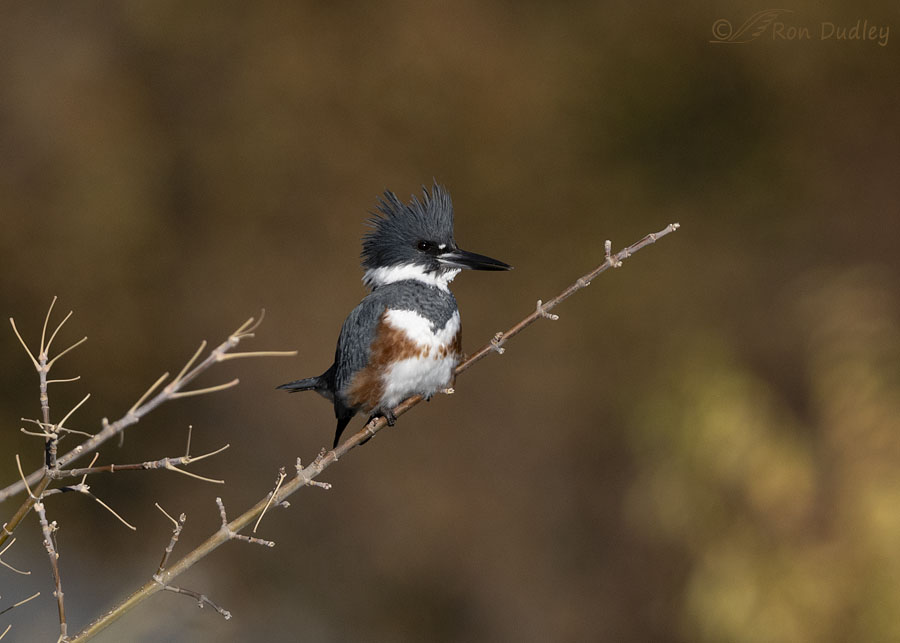
1/6400, f/6.3, ISO 640, Canon R5, Canon EF500mm f/4L IS II USM + 1.4 tc, not baited, set up or called in
Yesterday morning, when I found this female fishing above one of the ponds, I had to “micro-tune” the position of my pickup in order to have any chance of getting a background I liked. There were houses behind the trees that would very likely ruin the backgrounds of any diving shots I might get.
I wish she’d been closer so I could get better detail but there’s an upside to being farther away from kingfishers when they’re fishing. Their dives on fish are explosively fast so being farther away gives me more room to keep them in frame during a dive.
This time I got three shots of her in diving flight before she was out of frame. I like two of them, but you won’t be seeing the third because in that one there were out of focus leaves in front of her.
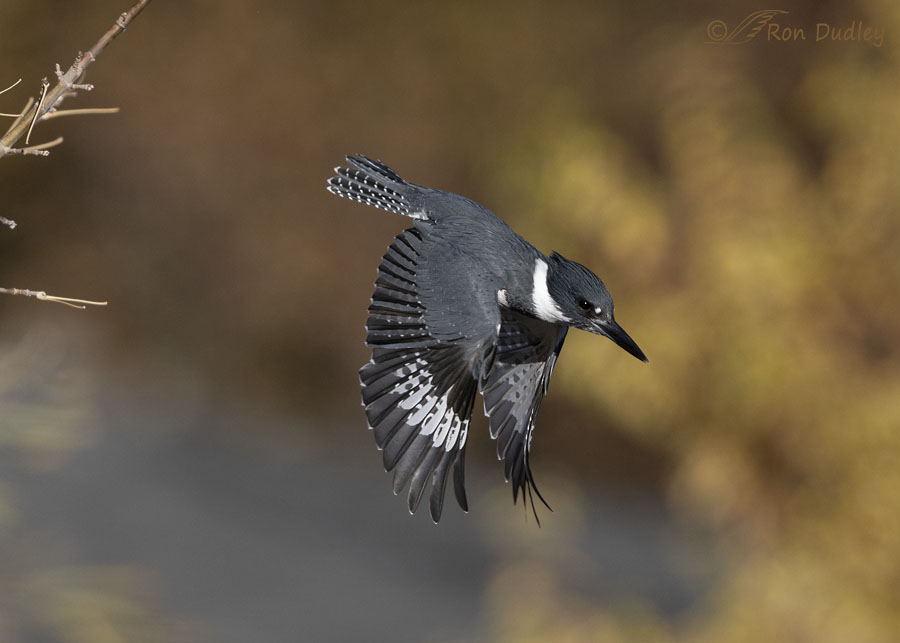
1/5000, f/6.3, ISO 640, Canon R5, Canon EF500mm f/4L IS II USM + 1.4 tc, not baited, set up or called in
This is the first one. She’s nearly centered in the frame because I wanted to include part of her fishing perch at upper left.
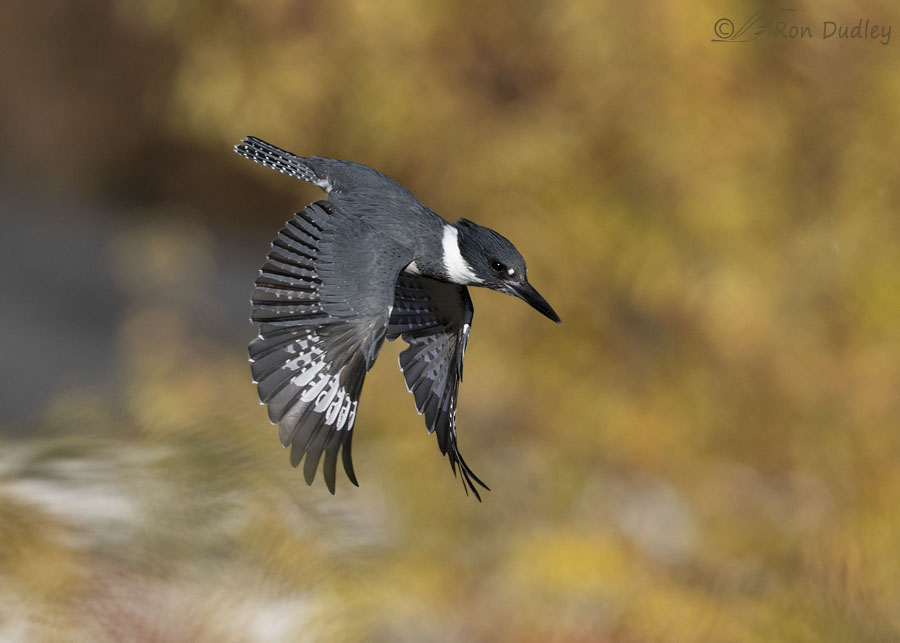
1/6400, f/6.3, ISO 640, Canon R5, Canon EF500mm f/4L IS II USM + 1.4 tc, not baited, set up or called in
This is the second one. Her flight posture in both photos is almost identical, but the backgrounds are quite different.
The more I looked at this background, particularly near the bottom of the frame, the more I was intrigued by all those swirly patterns and colors.
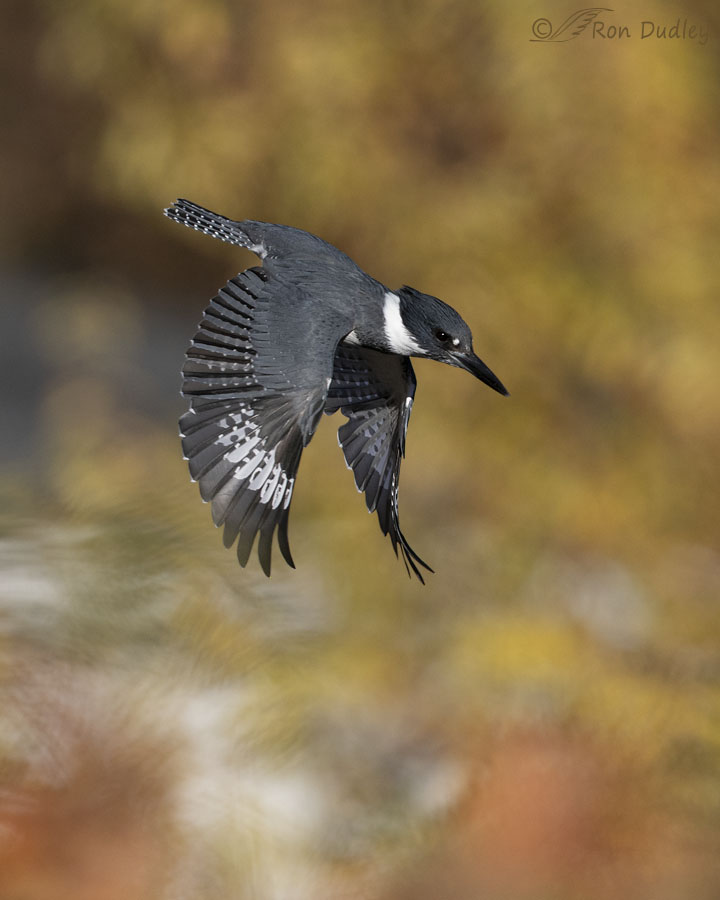
So, I tried a more unconventional composition of the same photo that included more of the background below her.
I love the bokeh in the bottom third of the frame. The golds and reddish-brown hues come from the fall colors of two species of trees. And believe it or not, those whites come from a house in the far background.
My lens is known for the quality of the bokeh it produces and this time I think it outdid itself. The beauty and appeal of background bokeh is in the eye of the beholder but for my tastes this one couldn’t be more interesting.
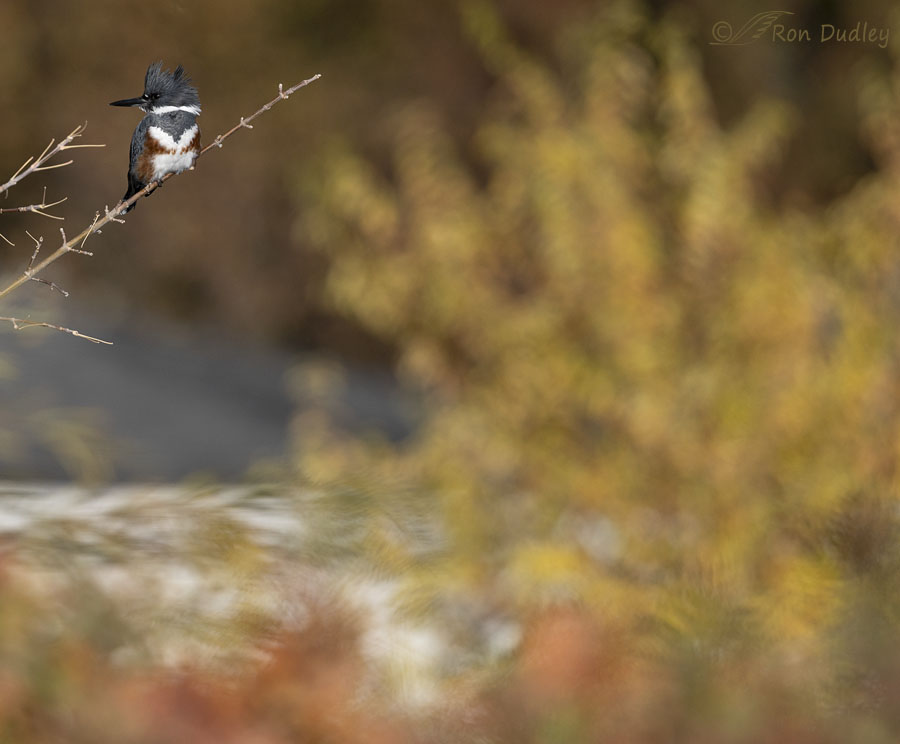
1/6400, f/6.3, ISO 640, Canon R5, Canon EF500mm f/4L IS II USM + 1.4 tc, not baited, set up or called in
I’m only including this shot to give readers a better idea of the origins of those colors and patterns and how far away I was from the bird.
Oh, and by the way. She caught a fish on this dive and returned with it to the same perch.
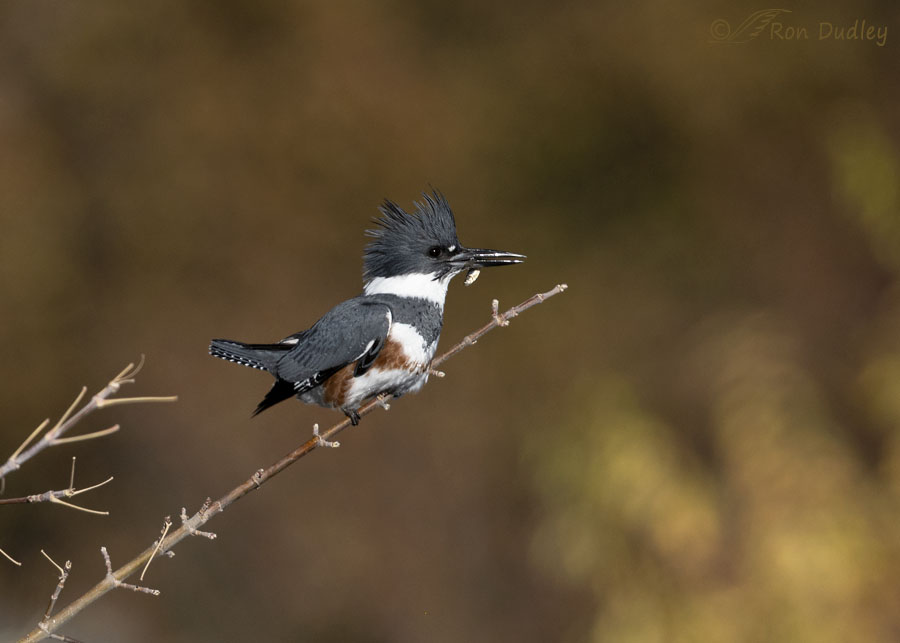
1/5000, f/6.3, ISO 640, Canon R5, Canon EF500mm f/4L IS II USM + 1.4 tc, not baited, set up or called in
But it wasn’t big enough to write home to Mom about.
Ron
Note: Just to be clear, I pulled no processing shenanigans with any of these photos. The backgrounds (and bird) are just as they came out of the camera.
Did you have to crop significantly to get the bird the size you did in the frame? I’m getting the impression from the images that you did.
Yup, I did, Steve.
Hi, Ron! My brother and I were researching Black-billed Magpies and came across your photos from years ago; so glad to see you are still active. Your website is lovely and I will definitely be bookmarking to keep up with you!
As a flower photographer, learning how to create backgrounds like these was one of my first challenges. It can be the only way to highlight a specific plant when it’s tangled up with a mess of other growth. Of course, there’s always the technique of laying flat on the ground and shooting upwards, although that risks passersby stopping to be sure I’m not dead!
I rarely see Kingfishers, but there’s no mistaking their chatter. It’s an announcement that they’re around, even if not seen. I’m glad you saw these, and captured such wonderful views of a bird I usually see sitting on a wire, well out of my camera’s range.
“there’s no mistaking their chatter”
That’s for sure, Shoreacres. I’m thankful for that chatter. Without it I often wouldn’t know there was a kingfisher anywhere near me.
Fantastic! I agree with Mark about the sunflowers a bit of Monet in your composition.
Take Care,
Kaye
Thanks, Kaye.
“…this one couldn’t be more interesting.”
Agree. Very nice!
“…this time I think it outdid itself.”
So did you.
Was not familiar with the term bokeh. Once again professor, you have educated.
Thank you, Michael. Then I’m glad I included the link for bokeh. I almost didn’t.
She is one gorgeous little bird, as is her background. So glad she got her fish!
I was away when your post on Magpie/Kestrel playtime arrived. What fun that was! I’m picturing you twisting and turning to catch all that activity. Thanks for documenting it all – so many fabulous photos.
“I’m picturing you twisting and turning to catch all that activity.”
You picture correctly, Carolyn. My back took two full days to recover.
Wonderful images, Ron, fun to see the intense Madam Kingfisher in diving mode (and coming up with a prize, no matter the size), and bokeh used to its best effect! I’m with Kris, it’s great that you are finding worthwhile photography subjects in your own backyard (as it were). ❤️
Thanks, Chris (and Kris). It’s hit and miss “in my own back yard” as it were but it’s sure convenient having it so close – just down the hill.
The bokeh is gorgeous, “Mr. Van Gogh” — the autumnal version of Starry Night. The lens may help, but there’s certainly skill behind it!
Speaking of skill, I’m impressed by the lovely kingfisher (or should I say queenfisher 😉) for being able to not only pluck that tiny nugget from the river, but also see it in the first place!
“the autumnal version of Starry Night”
Insightful observation, Marty – partially because of the ‘swirls’.
Thanks again for sharing the stories you see through that viewfinder. I’m amazed that a lens can create such a cool background effect. I’m starting a journey into learning more about photography and am intrigued by the settings you share so kindly. About how far away was the bird? Plus, it’s amazing to see a kingfisher so “close”. In my life they’re a little blob on the power line over the river.
“About how far away was the bird?”
Jean, it’s only a guess but I’d say about 60′. I cropped most of these shots quite a bit.
WOW!! Amazing photography – and a great narrative to go with it.
The fisher is so clear – with even the “spark” in its eye. GOOD JOB! THANKS!
Thanks very much, Judy.
Wonderful shots– every little white dot of her markings is crisp,
and the soft, swirly patterns in the bokeh further accentuates
the bird’s very precise markings……I’m glad for you that you can find satisfying subject-matter without trekking to the boonies every time !
Kris, I always knew that “trekking to the boonies” burned up a lot of gas, and ate into my bank account, but now I’m realizing just how much.
Wow. Gorgeous, Ron. Thank you. All this, and a catch-light in every one, even that small last one.
Catch lights make a difference, don’t they Ellen. Thanks for noticing.
So full of fall colors! Have never seen a Kingfisher – delightful bird. 😀
Hope you get to see one, or more, sometime Kathleen.
Ron: this series of shots is exquisite. And, as usual, the clarity of your text is unbeatable.
Thanks on both counts, Ricardo.
Excellent Ron. October/November must be Kingfisher time, I
have been seeing lots of them lately.
“October/November must be Kingfisher time”
Everett, trees shedding their leaves is likely part of that equation.
Beautiful! Both the Kingfisher and the bokeh!
Thanks, Judy.
Very impressive series – you give too much credit to your camera (which is superb, but does not manage a series of shots like this without a pro like you behind its lens). I’m dying of curiosity re the grammar tip: are vs is?
“I’m dying of curiosity re the grammar tip”
Further versus farther, second paragraph below the first photo.
Beautiful series, Ron. I specialize in “out of focus leaves”! 😄
“I specialize in “out of focus leaves”
I have another photographer friend (on Facebook) named Diane that specializes in the same thing.
Really lovely! And thanks for teaching me a new word, too. (Now, check your email for something from me. . .)
Thanks, Sue. And thanks also for the grammar tip. Fixed.
Of course! I didn’t want to “correct” you in public, but you don’t seem to be bothered by that!!
Sue, grammar isn’t my strong suit so I might as well fess up. Feedback like yours helps me get better.
Lovely series, Ron. I love the bokeh on these images as well! Thanks once again for “pulling back the curtain” on your process.
“Thanks once again for “pulling back the curtain” on your process.”
Thanks for noticing and appreciating that, Thomas.
Absolutely beautiful Ron. I love the swirly patterns and the upper and right side background look like impressionistic sunflowers to me. Oh, the Belted Kingfisher is quite striking as well.
Thanks very much, Mark. Interesting observation about “impressionistic sunflowers”.