

Yesterday morning I got lucky at the trumpet vine.
- I believe both of these hummers are Black-chinned Hummingbirds. Please correct me if I’m wrong.
- The five photos below are consecutive shots in a burst, with an elapsed time of less than 1/10th of a second between each shot. The entire sequence lasted significantly less than half a second.
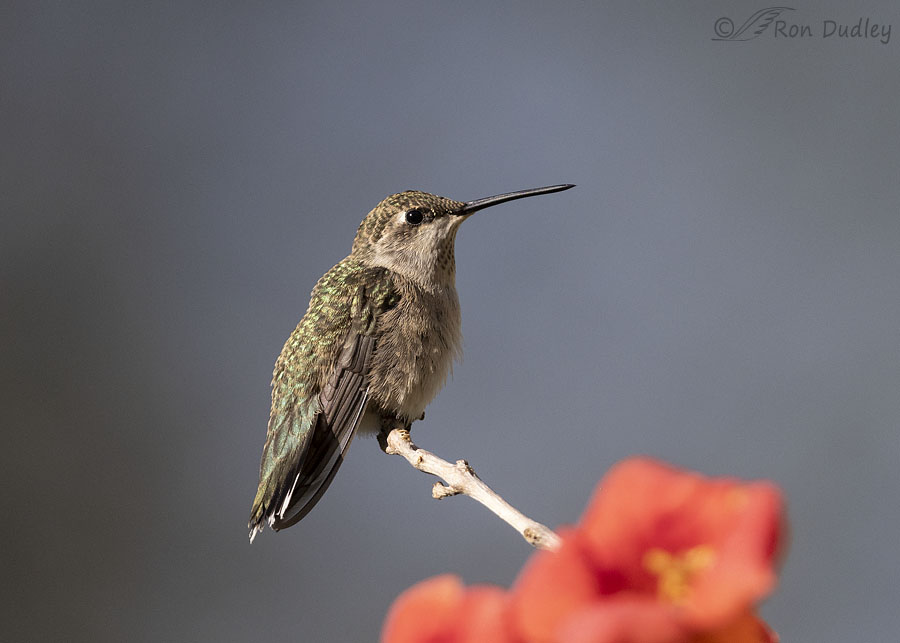
1/5000, f/5.6, ISO 1000, Canon R5, Canon EF500mm f/4L IS II USM + 1.4 tc
It all started with this hummer taking a break on her favorite resting perch after an extended period of feeding on the trumpet vine flowers. Suddenly she was…
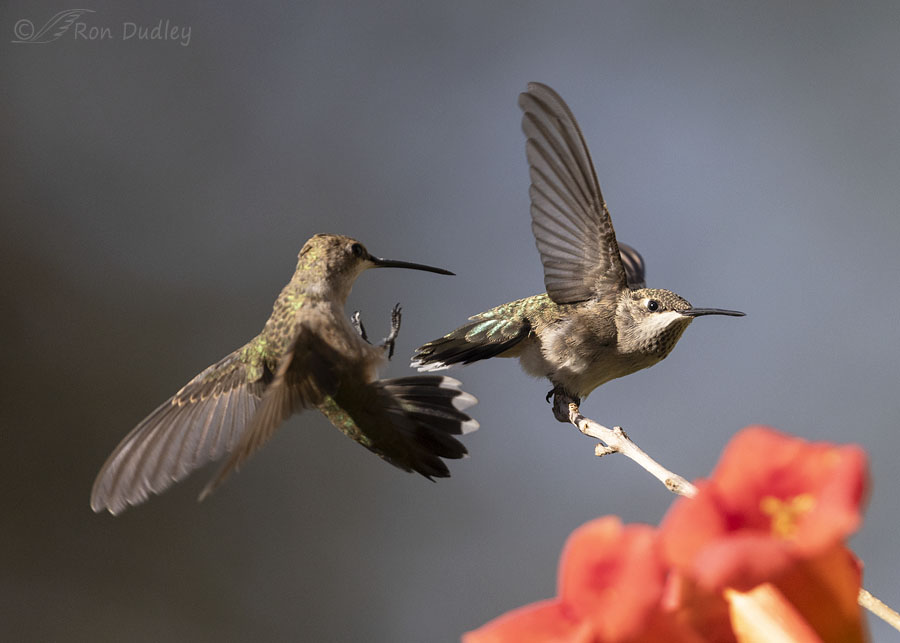
1/4000, f/5.6, ISO 1000, Canon R5, Canon EF500mm f/4L IS II USM + 1.4 tc
ambushed from behind by another hummer with mayhem on its mind. She took off just in time, but she didn’t go far.
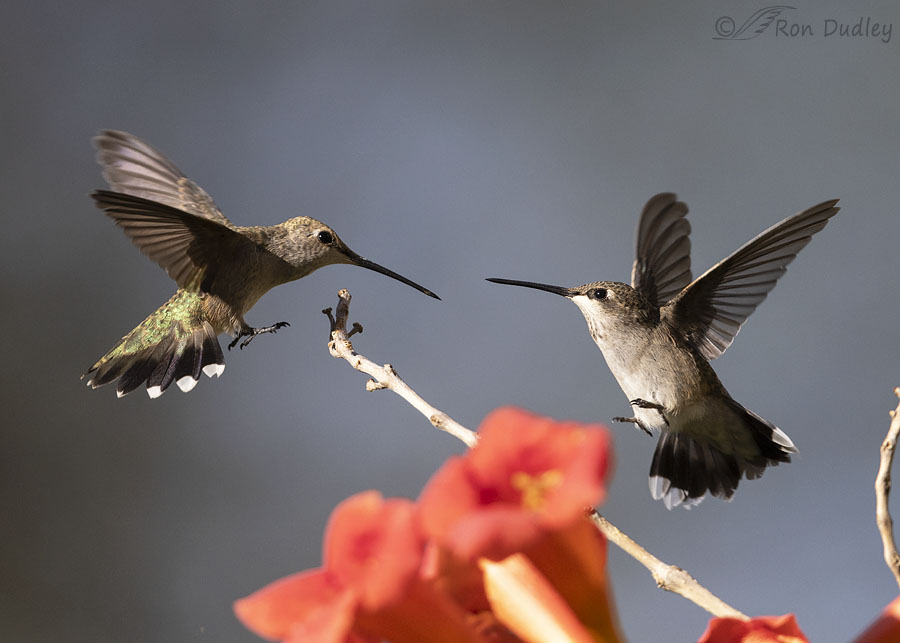
1/5000, f/5.6, ISO 1000, Canon R5, Canon EF500mm f/4L IS II USM + 1.4 tc
I was amazed by how fast she was able to turn around in flight and face her attacker.
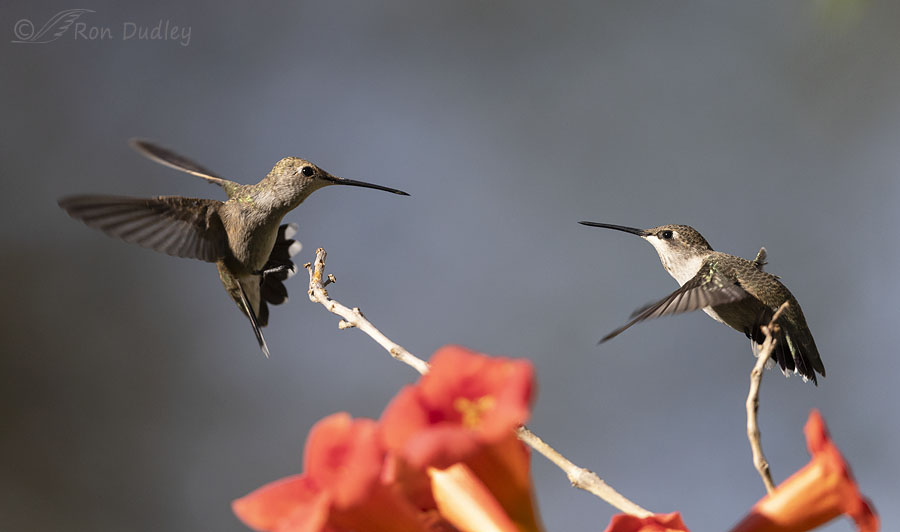
1/5000, f/5.6, ISO 1000, Canon R5, Canon EF500mm f/4L IS II USM + 1.4 tc
She backed up a couple of inches (yes, hummingbirds can fly backwards), apparently while trying to decide whether to fight or flee.
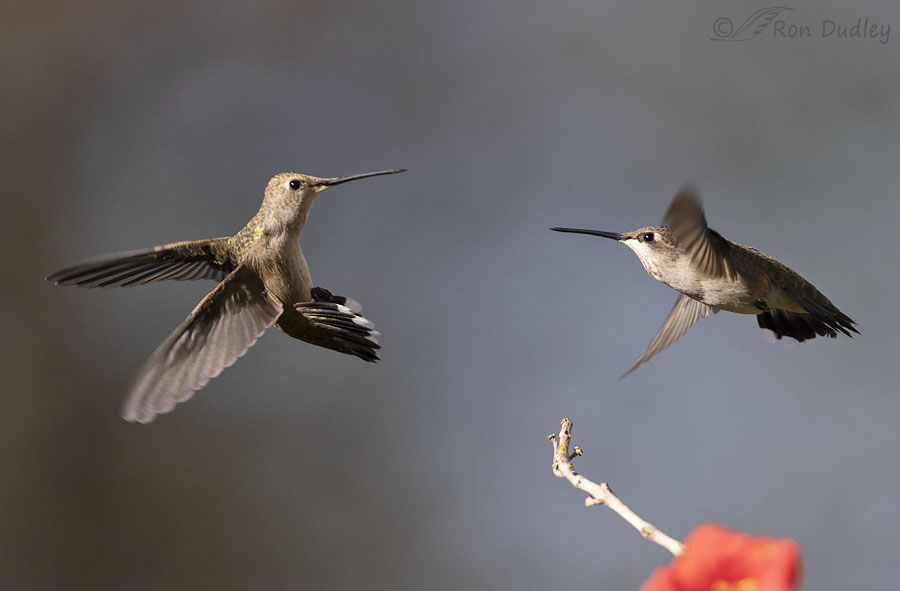
1/5000, f/5.6, ISO 1000, Canon R5, Canon EF500mm f/4L IS II USM + 1.4 tc
She chose the former so she rushed forward, which made the attacker put on its brakes, abandon its attack and fly off. In the next shot in the burst, both birds had flown out of frame at upper left. The only part of a bird left in the frame was the tail of one of the hummers, probably the one on the right.
I’ve found that trying to get quality photos of fighting hummingbirds is a humbling experience. I’ve been trying for years with little to no success. They’re just too fast and agile and my reflexes are too slow.
So getting these four consecutive shots yesterday, with neither bird clipped or cut off, both birds sharp or sharp enough and a catch light in the eye of both birds most of the time, was highly rewarding.
After all those years of trying, it’s about damn time.
Ron
Wonderful captures Ron!
I was looking at your shutter speeds to see what I need to do to prevent the wing blur in my recent hummingbird shots. I noticed the shutter speed of the second photo was different from the four other images. Is that a typo? Isn’t shutter speed the same for all the shots in a burst? I need to double the shutter speed I have been using when taking shots of hummingbirds.
Thanks, David.
No, it isn’t a typo. It’s accurate. I shoot in aperture priority so my shutter speed can, and often does, vary with the light intensity. I generally use ISO to control shutter speed.
Thanks. A manual mode shooter’s mistaken interpretation of the data.
AMAZING! (A great story & presentation for your YouTube series.)
I didn’t realize that these little creatures would actually fight each other. Thanks for sharing.
Judy, hummingbirds are more pugnatious than prize fighters.
Just want to add my kudos and appreciation for your exceptional HB shots!
Thanks, Burrdoo.
Great capture of hummer behaviour! Do you have any data on bird flu in hummingbirds?
Thanks, Brett. Sorry, I don’t.
sensational!
Thanks, Charlotte.
Great shots, congratulations! I think the first bird is a juvenile black-chinned, the beak seems shorter and broader. Their beak seems to thin out as it grows longer by just a bit.
You’re probably right, April. I figured one of them probably was and your rational seems logical that it was the one on the right – the “first bird”.
It was good to see you the other day. It had been a while.
It was good to see you too, you need to update your photo now you are sporting a handsome goatee!
You spilled the beans! 🙂
Luck is nothing without the skill to take advantage of it. 🙂 What a series, Ron! These two remind me of a couple of kestrels in their feistiness.
Thanks, Marty. Now I’ve got to try to photograph fighting kestrels. 🙂
They are faster than any of our reflexes Ron, but you got them
good. Outstanding job.
“They are faster than any of our reflexes”
You’re right about that, Everett. I may have been just lucky to have started my burst when I did. Don’t think I had time to react as early as I did when the second hummer entered the frame.
Remarkable photos of one of the most remarkable birds in nature.
All in less than half a second! Astonishing.
Have read that Hummers can fly backwards, and that they are the only bird that can do so.
Thanks, Michael. They can also fly upside down. I may have a post about that soon.
These are excellent! Congrats. So crisp and clear and a capture of interesting behavior. What a delight!
Much appreciated, Kathryn.
Great success!
Thanks, Bruce. I’m pretty pleased with them.
Congrats! These are great shots Ron! The migrating Rufous showed up yesterday. We have 10 fighting at our feeder. Love this time if year when they stop by!
Thanks, Kathleen. I haven’t seen Rufous hummers for three days now. Hope they haven’t left already.
WOW! Glad the combination of “luck” and skill were with you! 🙂 Hummers ARE a challenge to photograph with their, often, erratic flight. Hard enough to track them without trying to capture them on film IMO….. 😉
Our yard is errily quiet bird wise for this time of year. Not as many birds this year period…… “Labor Day quiet” probably won’t have it’s usual meaning this year.
Thanks, Judy. Birds have slowed down here too. Even the neighborhood Cooper’s Hawk has stopped showing up – probably because of fewer songbirds at my feeder.
Fantastic sequence! Congrats on capturing this so beautifully.
Thanks, Sheila.
Bravo Ron! What an incredible sequence. It’s amazing that so much movement can take place in a fraction of a second. And you captured it beautifully. I love the birds, the flowers, the background, and the perch over which they seem to be fighting.
I’m so glad it all came together for you and we all benefit from your persistence and talent!
Thanks very much, Mark. Your point about how fast this all occurred is exactly why luck played a part in me getting these photos. But if you try long enough and often enough, sometimes it eventually pays off. It sure took a while though.
Wonderful captures! Well done.
Thank you, Dan
Amazing shots of the hummingbird “fight club”, so perhaps I should follow the first rule.
Thanks, Suzanne.