

And dumping a load.
In the last week I’ve spent many hours at my trumpet vine trying to photograph hummingbirds, with almost no success.
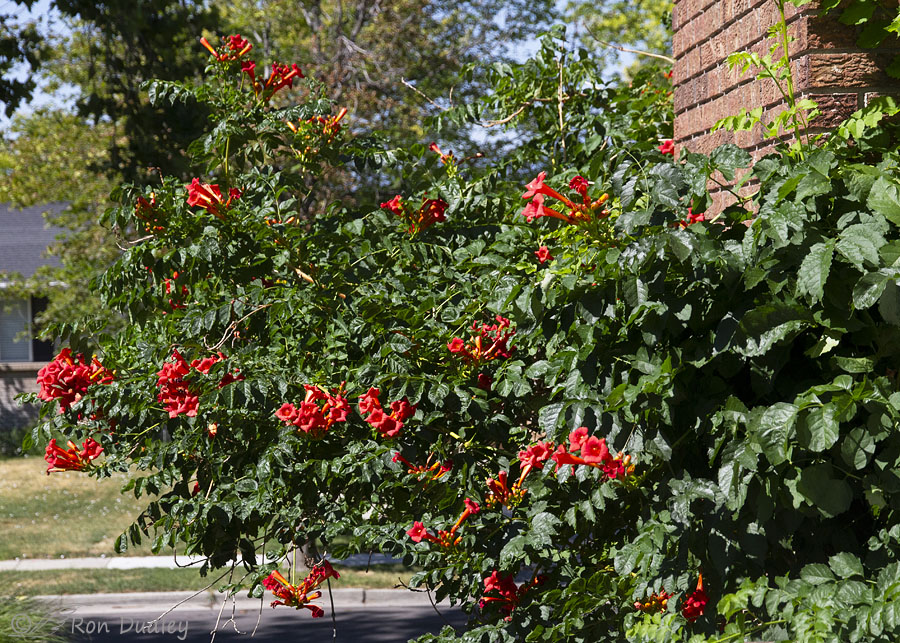
This is my trumpet vine, growing on my chimney on the east side of my house. This year it has an abundance of flowers but they were late blooming, probably because I gave it a serious pruning early in the spring.
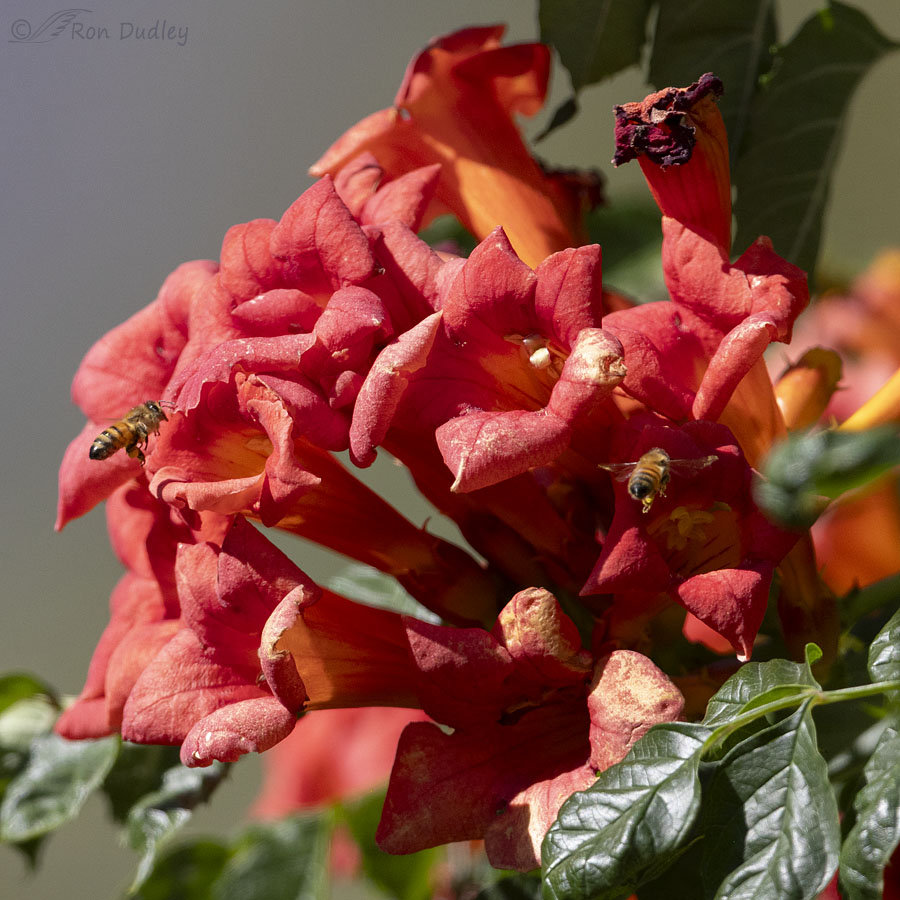
Pollinators, including at least four species of bees, are drawn to it in droves. But this year, hummingbirds – not so much. I’m seeing fewer hummers than I have in past years and those I do have come to my hummingbird feeder in my back yard but they’ve been mostly avoiding my trumpet vine and I don’t know why.
But I’ve been persisting. In the last week I’ve spent at least 10 hours sitting on my deck in front of my tripod, waiting for hummers to show up. In that amount of time I’ve only had a hummer in my viewfinder twice and I didn’t like any of those photos.
But yesterday morning my stubbornness finally paid off when I got…
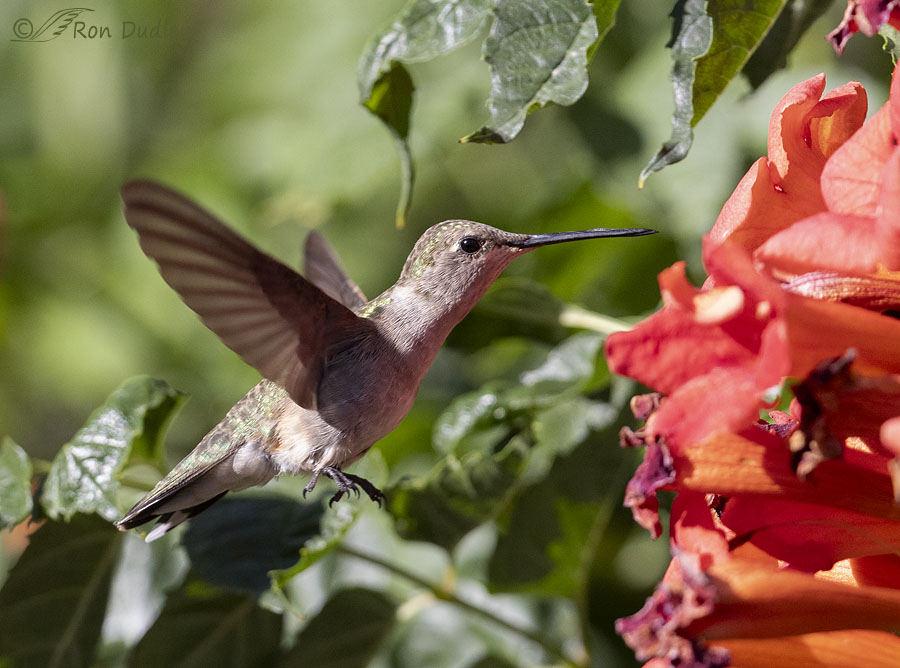
two series of photos of this female Black-chinned Hummingbird feeding on trumpet vine nectar. In this series the flower cluster she was feeding on was a little past its prime.
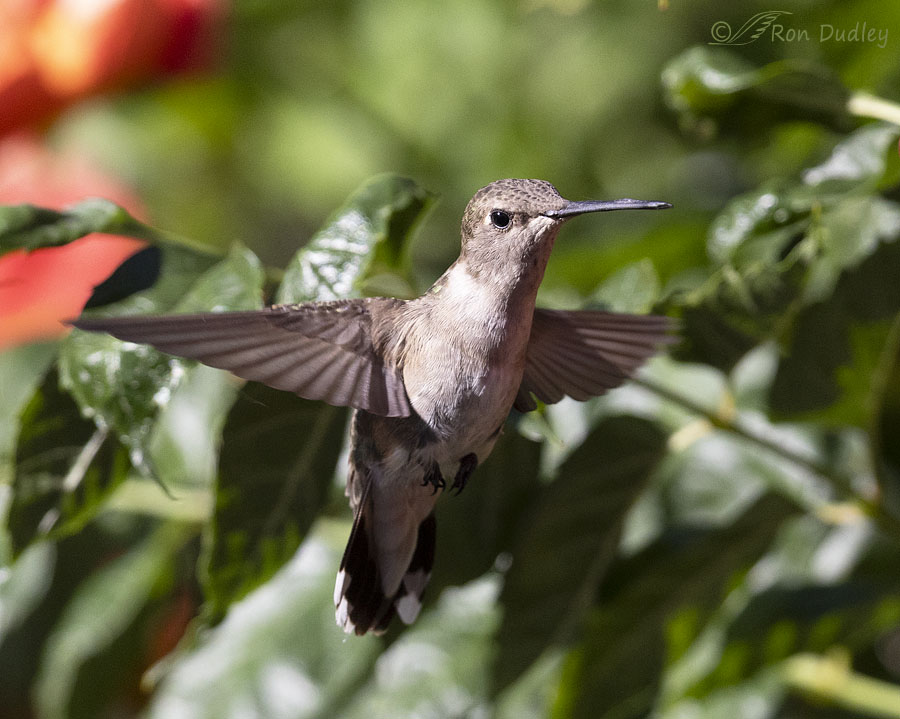
In this shot she was far enough away from those same flowers to allow me to crop them out.
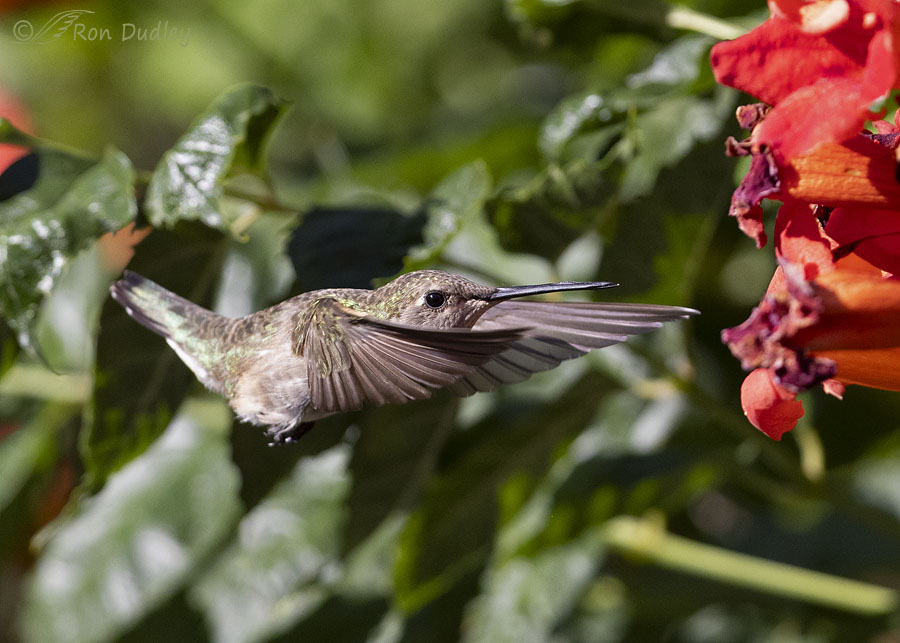
Here I like her horizontal flight posture. And her apparent determination. In this series the background was pretty cluttered but a few seconds earlier I managed to get a series of photos of her with a…

much cleaner background.
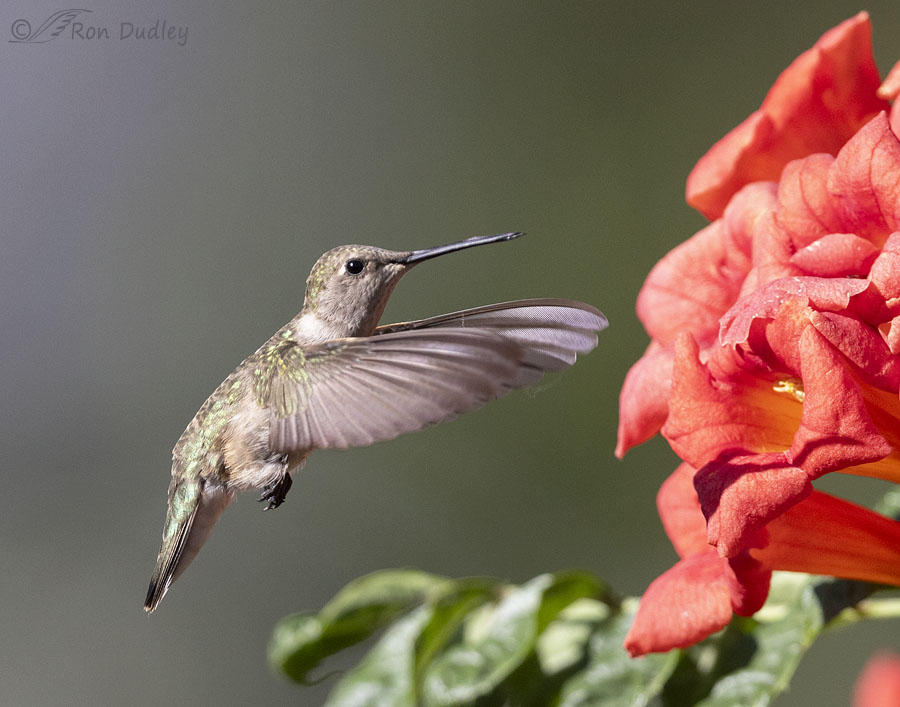
In this shot the flowers are a little sharper.
In the last photo below she isn’t very sharp, but I think you’ll understand why I’m including it anyway.

In the past I’ve photographed hummingbirds pooping several times but I’ve never captured this much of it. She’s dumping quite a load for such a tiny bird. That’s a small, out of focus bee at upper left.
As in most birds, hummingbird poop can consist of water, nitrogenous wastes and dark, undigestible insect parts (hummers do eat some tiny insects for the protein they contain). But hummers feed primarily on watery flower nectar so their poop is mostly sweet-smelling water. This time her poop appeared to be entirely water.
Sweet-smelling poop, now there’s an idea.
Ron
Notes:
- Image techs for the hummingbird photos in this post are at or near Canon R5, Canon EF500mm f/4L IS II USM + 1.4 tc, 1/4000, f/6.3, ISO 1600
- I must still have garden tomatoes on my mind because the flowers in this post keep reminding me of the color of ripening tomatoes. Maybe that’s because yesterday I found enough ripe tomatoes and jalapeno peppers in my garden to make my first batch of salsa this year. It was, and still is, delicious.
An old medical student joke. Instructor is giving a lesson about the importance of observation. She says that if you want to diagnose diabetes you can always taste the urine. She demonstrates by putting a finger in some urine and saying – you can taste the sweetness. This person has diabetes. Asks the class to do the same. Reluctantly they do. She says: you all fail. I put in my index finger and tasted my middle finger
Smart instructor!
Nice isn’t it sitting inside waiting for that perfect moment? Lovely captures. I wonder if they realize how beautiful they are? Her little tickles are cute.
Linda, I wasn’t inside but it was still nice on the deck, especially in the morning.
Great shots as well. Let me add a bit about that last shot. Hummingbirds are unique in many many ways. Peeing is just one of them. Most birds deal with ammonia, which is a breakdown product from protein digestion, by converting it to uric acid which forms crystals, leaving those familiar white spots all over your car. Hummingbirds are feeding on nectar so often that they have an excess amount of water. They need to get rid of this water frequently so hummingbirds constantly pee, and rather than convert the ammonia to uric acid, which is energetically expensive, hummingbirds dilute the ammonia with the water they are constantly drinking from the nectar liquid. Mammals convert the ammonia to urea, which is less toxic and dilute it with water and store it in their bladder to eliminate later. The extra weight of that much water would be detrimental to birds, hampering their ability to fly. But hummingbirds have taken this a step further and don’t even bother to make much uric acid, but simply pee out the ammonia constantly.
Thanks very much for the detailed clarification, Dan.
Glad your persistence finally paid off—these are nice pics of such a pretty little hummer (and her “poo”)! Interesting that you’re seeing so few this year … my sister (in northern ID) was complaining a few weeks ago about no hummers there, but now she says she can’t keep her (5) feeders filled each day. Yours may yet show up in force!
“Yours may yet show up in force!”
I hope they do, Chris. I suppose it could happen with migrating Rufous hummers.
Beautiful shots – but trust you to catch a “woman” indisposed. The humming birds in Gilbert were beautiful – and so prolific when the citrus was in blossom. We loved to watch them flit from one blossom to another. Never saw with the naked eye – what you treated us to today. Keep at it.
“but trust you to catch a “woman” indisposed.”
Made me smile, Judy. Guilty as charged.
Love the 4th shot of her – nice face capture framed with your gorgeous trumpet vine! We should have our Rufous migration here in 2ish weeks! In the meantime we are highly entertained with a few Annas fighting over the feeder. Hummers are my fav! ❤️
Kathleen, it’s been two years since I’ve seen any Rufous in my yard. They used to migrate through regularly. I miss those feisty little rascals.
Very interesting. Got me thinking that I am not sure if I have ever seen a Trumpet Vine. Will have to be more observant around the neighborhoods. That horizontal photo is really good. I have always enjoyed watching our hummers work around the yard. We have almost exclusively Anna’s. Around our lakes and other natural locations we have a wide variety of hummers, but in the yard only Anna’s.
Everett, some folks avoid planting trumpet vines because their vines can cause damage growing on houses. But when I keep mine confined to my brick fireplace it isn’t a problem.
Morning Ron
I’m thinking maybe the bees might be keeping the hummers away. That what was happening at my feeder. Love how the flowers are clustered together.
Diana, in previous year the hummers at my trumpet vine weren’t particularly bothered by bees, and there were a lot of them. They just avoided the bees and went about their business.
BEAUTIFUL! 🙂 Luv those stubby little legs……;) The trumpet vine IS beautiful and can see why pruning is a must. Hope it’s a one off that there are few hummers.
Beautiful 56/no wind/sunny morning here so had to “stop a smell the roses” for awhile with a cup of coffee and my stock tank pond in view chores be damned! 😉 Going to be a scorcher today and tomorrow – sighhhhhhh
Thanks, Judy. Do you have AC? Lots of folks in MT don’t have AC because the nights cool off so nicely (we never had it). But when you need it, you need it.
Have a window unit in one bedroom that “helps” even if I hate listening to it! 😉 Growing up we slept out in the back yard as that old 2 story house WAS an oven at times…….. Most of this house was a one room school house at Big Sag originally sooooooo
Fantastic photos Ron. Brilliant as always.
Hummingbirds never cease to amaze me. Now I learn that they produce sweet-smelling poop!? Which begs the question, who and how was this determined? Seems a bit of a challenge from sample collection to test method. Captive subjects? Geez. Ah well, its all science I guess.
“Which begs the question, who and how was this determined?”
Michael, I wondered the same thing. You and I are too much alike…