

Wilson’s Phalaropes played a significant role in my bird photography on my recent camping trip to Montana’s Centennial Valley and Red Rock Lakes NWR. On one evening, while I was photographing birds at what I eventually began to call my “sweet spot” on Lower Red Rock Lake because it was so productive for birds, I had an interesting encounter with a lone male phalarope.
Wilson’s Phalaropes are well known for their reversed sex-role mating system. Larger and more brightly-plumaged females compete for mates, while males provide all parental care. Just the opposite of most birds.
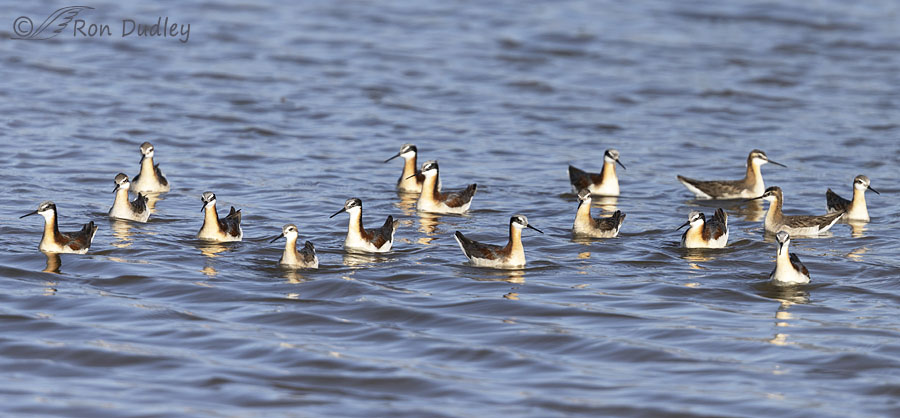
Which I believe might explain why all or most of the phalaropes in this group are the more colorful females. It was breeding season and since incubation and brooding are done only by males, I suspect most of the males were on their respective nests.
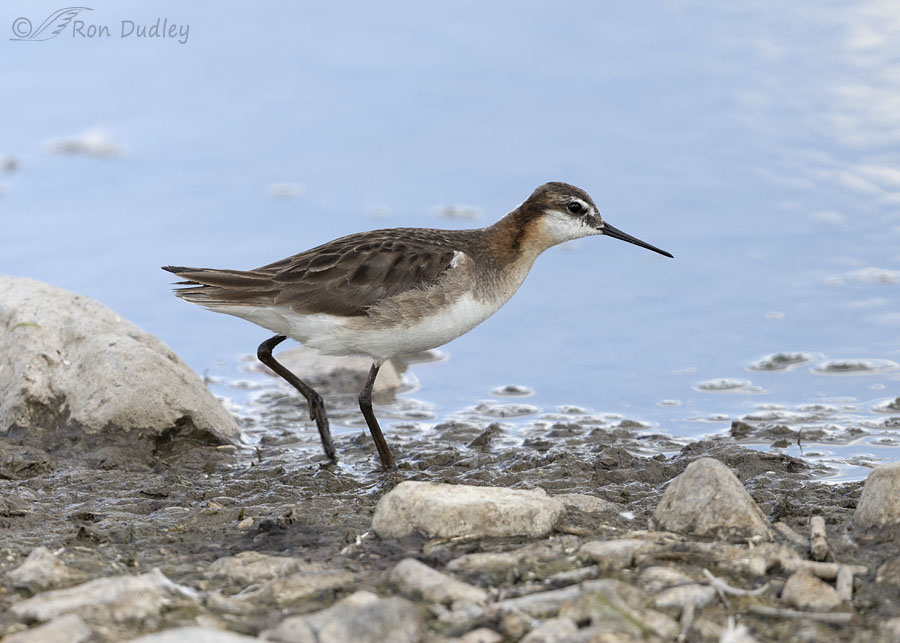
This was one of the very few males I saw out and about while I was there. On a cloudy evening he landed very close to me while I was photographing Willets on the shore and I immediately noticed that he had a severe limp. In this and other photos I got good looks at his feet and legs and didn’t notice any injury, but he was obviously hurting and with limited mobility.
His injury may (or may not) have affected his choice of feeding strategy. While feeding, Wilson’s Phalaropes typically employ a strategy called “spinning”, where the bird spins round and round in shallow water, creating a whirlpool that sucks invertebrates up to the surface where they’re captured and swallowed.
But with his injured foot or leg, he couldn’t spin.
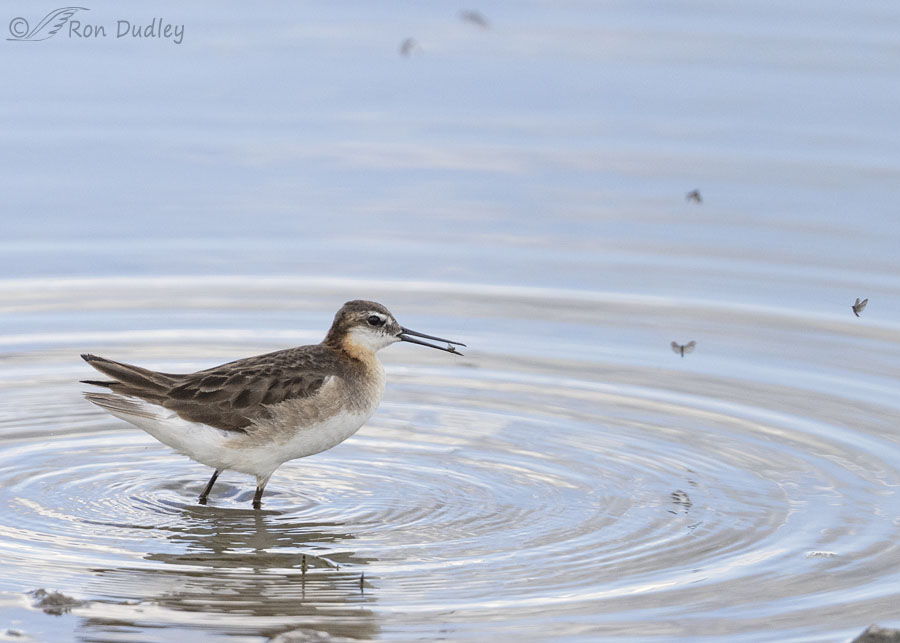
So he moved to shallow water and began to spear flying insects out of the air. He was good at it too.
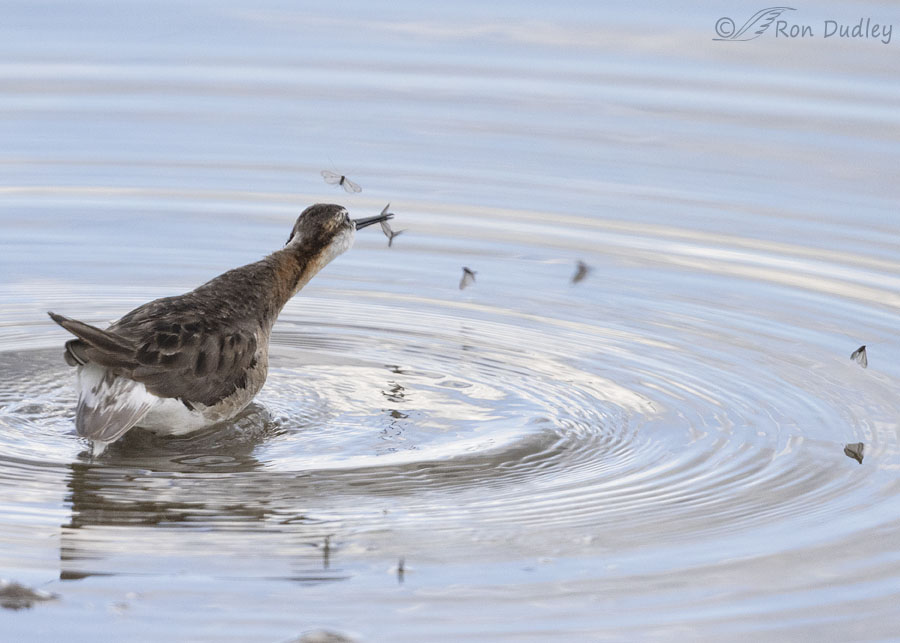
There was an insect hatch going on so he had plenty of opportunities.
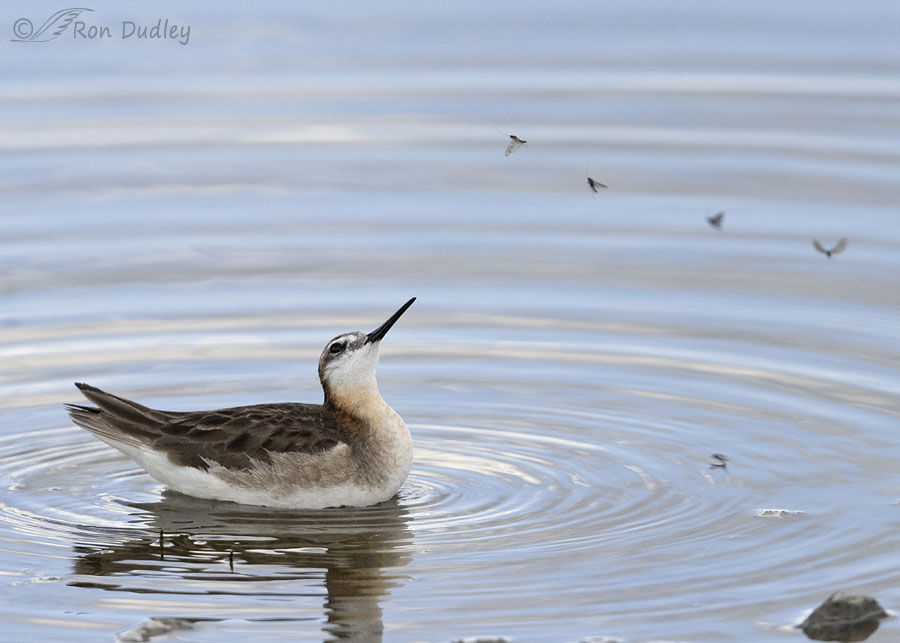
Here we see four of them all lined up, ready to be plucked out of the air.
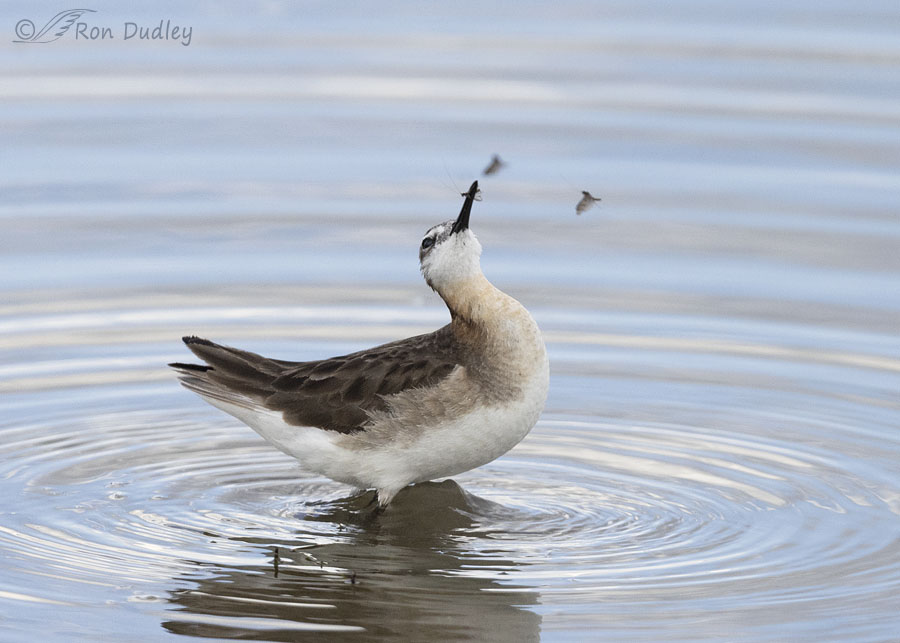
In the next shot in the burst he got one of them too.
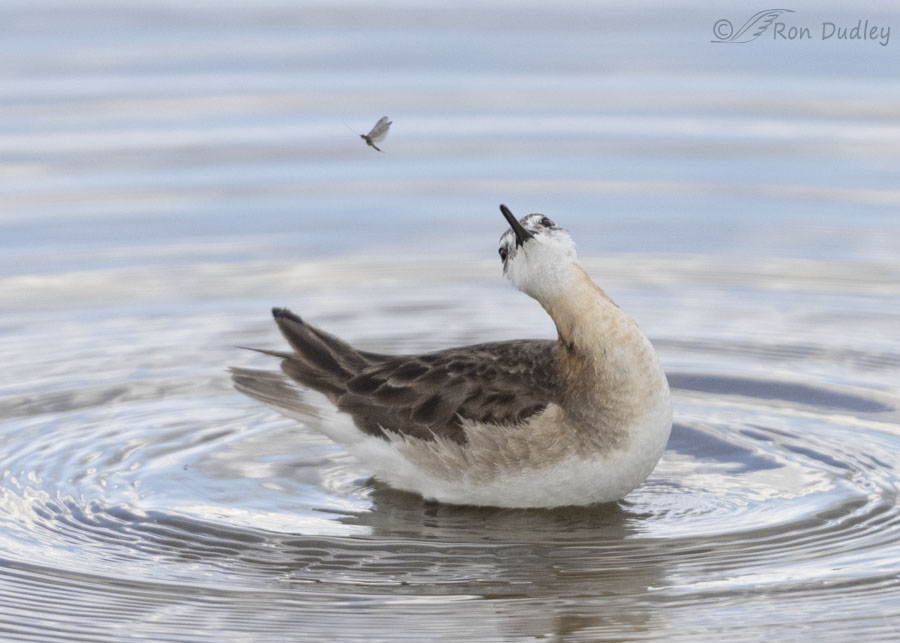
With his long flexible neck he was very good at snagging them out of the air, no matter at what angle they were relative to his body. All they had to be was “close enough”.
At times his snapping angles were so extreme to the position and angle of his body I thought he might break his neck with one of his very quick and awkward-looking lunges. So, time and again I tried to capture his head and neck at one of those extreme angles, with very little luck. He was just too fast and my reflexes too slow.
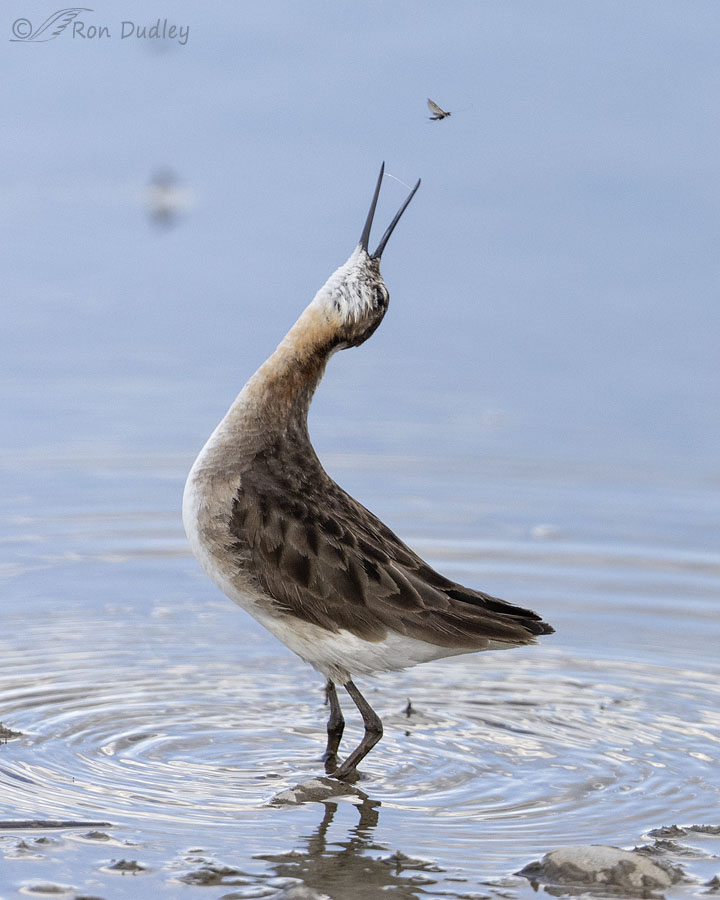
This is as close as I came, but no cigar. Sometimes his upside-down head reached back so far it was behind his tail but I was never able to capture it in that position. The poor light and resulting shutter speeds that were often too slow didn’t help.

This huge crop of one of my photos gives us a fairly detailed look at one of the insects he was capturing. I’ve been at the refuge on other camping trips when this insect species was involved in a hatch. With their double ‘tails’ they remind me of mayflies but I don’t really know what species they are.
I wish I did.
Ron
Notes:
- When I arrived back at my campsite that evening there were thousands of these flying insects, all dead, attached to the east side of my camping trailer. I suspect that, like mayflies, the adults may live for less than a day before they die.
- Image techs for most of these photos were at or near 1/3200, f/5.6, ISO 2000.
Thank you, Ron. I have always loved and admired the spinning phalaropes, especially their unique and, for this feminist, envious mating and parenting behaviors. Your photos of the male snatching dinner from the air are beautiful. What a handsome fellow.
I’m so glad you got yourself back to the Centennial Valley again!
Cathryn
LOVE (and envy) that adaptability, flexibility and dexterity.
Loud applause for the child rearing division of labour too.
Yet another series to delight in.
Thank you.l
Glad you liked it, EC. Thank you.
A fantastic series – well done
Thanks, Gary.
That next-to-last shot is fantastic. You may wish it was this or that or the other, but you’re never satisfied with your work! But I often am more than satisfied. Awed. This is one of those. To me.
Thanks, Sallie. I was glad to get that shot – the best shot of the bunch of the behavior I was trying to capture.
Fascinating Ron. Learned something new again from the professor. You got a real knack for catching unusual and interesting behaviors, and getting such beautiful photos to document them as well.
“You got a real knack for catching unusual and interesting behaviors”
That’s because I’m always on the lookout for them, Michael. I’ve been fascinated by behaviors ever since I took an Animal Behavior class in college. Funny how that stuck with me.
Don’t ask me anything about the Statistics class I took in college. Can’t remember a damn thing.
Interesting article, Ron. I did not know about the reversed sex-role of the Wilson’s Phalaropes.
I love the photos of the lone male trying to catch what I think are Callibaetis mayflies (sometimes referred to as “Lake Mayflies”). There are several variant species of Calilibaetis. I am not sure which one these is. Are there trout in those lakes?
https://www.rickhafele.com/bug-blog/8m7ydza71stn45bdktfd2u9oxd68b9
Thanks very much for the insect ID tip, Ed. It looks good to me.
Yes, there are trout and other fish in the lakes and tributaries, including cutthroat trout, mountain whitefish, arctic grayling, rainbow trout, cutthroat-rainbow hybrids, brook trout and suckers.
Those fish draw some very serious fishermen, even though fishing is restricted to some of the tributaries to protect bird habitat. And to protect the very threatened arctic grayling. In 2022 there were only 73 individual grayling left in a small area of Red Rock Creek.
Excellent series, Ron! I only see Phalaropes in migration and I’m always a tad disappointed if they aren’t spinning. You have given me a new appreciation for this alternate foraging technique. Who knew they were so flexible?
Thanks, Diane. They do a lot of spinning on Great Salt Lake too.
The leg certainly wasn’t preventing him from feeding – a good thing! 🙂 Quite the series even if you didn’t get the one shot you REALLY wanted. Hopefully the wind from driving got rid of some of the “deposit” on your trailer tho I’m equally sure a good scrub job is always due after one of these trips…….. 😉
Judy, I sprayed the dried mud off my trailer a couple of days ago but it still needs a good cleaning. Didn’t notice any of these insects still on it when I did it.
Great photography Ron. With my camera I would never get close ups of birds grabbing insects. That group photo is amazing to me because we only get to see one or two here at a time.
Thanks, Everett. On that trip I took lots of photos that included many hundreds of phalaropes.
I like the phalarope’s child-rearing plan. 😂 Kudos to the individual chap (and, of course, to the chap who captured him on camera) for demonstrating that disability is not inability. Wishing him (the bird, not the cameraman😉) many more successful snatchings of insects!
“disability is not inability.”
Well said, Marty. Birds are adaptable, which is one of the reasons they survive with all the obstacles we place in front of them.
I really admire shot #5 ( “all lined up ” ) and #8–reaching back, both
for their compositional beauty and for their inspirational quality ; he’s
developed a feeding technique which apparently compensates very
well for his injury–“disability” wouldn’t accurately characterize his situation–I hope he wins a mate worthy of his fortitude !
Thanks, Kris. I found myself rooting for him with every stab.