

And an example of when my choice probably wasn’t the best choice.
These days most photographers, including bird photographers, use mirrorless cameras. Nearly all mirrorless cameras give the photographer the option of using the camera’s mechanical shutter or electronic shutter. Each shutter option has its advantages, including but not limited to:
Mechanical shutter advantages:
- Syncs with flash better
- More reliable than electronic shutters
- Less rolling shutter distortion because the entire image is exposed at once
- Better dynamic range than electronic shutters
Electronic shutter advantages:
- Completely silent, so ideal for wildlife and other situations where shutter noise is undesirable
- A longer life span than mechanical shutters
- No camera shake, since there is no vibration caused by the movement of the mechanical shutter
- Ideal for high frame rate video
- Very fast shutter speeds/burst rate, allowing the photographer to freeze incredible fast motion and take more photos in the same amount of time
But for me it mostly boils down to one thing. The major advantage of electronic shutters, incredibly fast burst rates, is also its Achilles heel – way too many photos to deal with.
I’ll use my Canon R5 as an example. With the mechanical shutter I get 12 frames/second, which for me is nearly always more than enough – even when incredibly fast birds are my subjects. If I were to use the electronic shutter, I’d get 20 frames/second which is nearly always way too many photos to deal with. In a 3 second burst I’d have taken 60 photos instead of 36 and every one of those photos has to be dealt with – stored in camera, downloaded to a computer, transferred to an organizer, reviewed and either deleted or processed.
No thank you! I’ll stick to the mechanical shutter. I do have a life other than sitting at my computer.
But on rare occasions I probably pay a price for that choice. Following is a recent example.
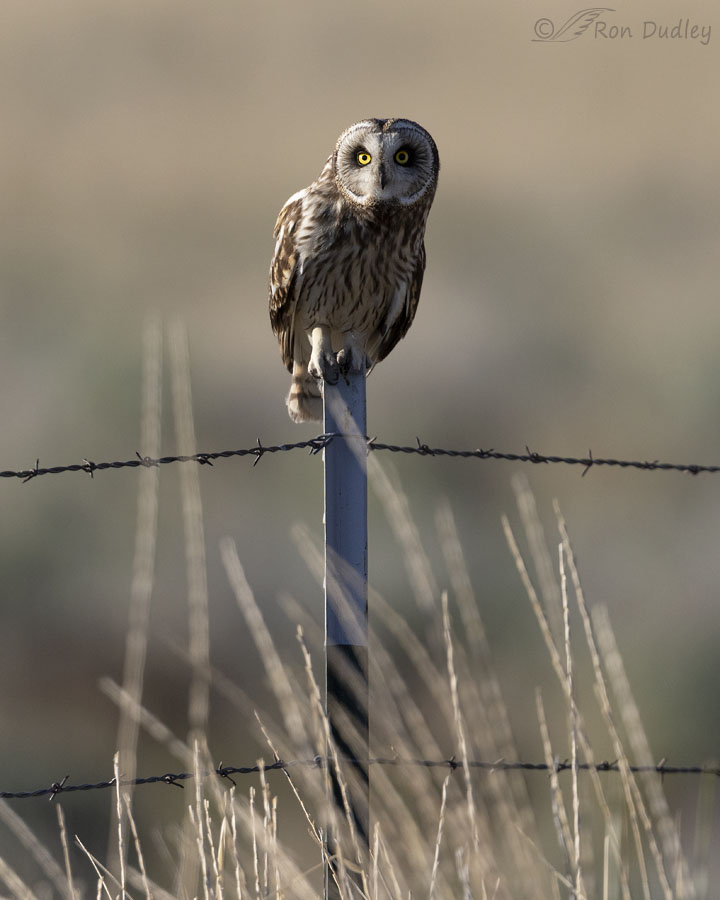
Nine days ago I photographed this Short-eared Owl hunting from a fence post. Yes, it’s the same owl featured in my last blog post. In that post I referred to this bird as a male, so I’ll continue to do so.
The grass below him was thick and tall so it’s highly unlikely that he’d be able to see prey on the ground. But immediately after this photo was taken, he must have heard a vole in the grasses to his left because in a nanosecond he went from looking at me to…
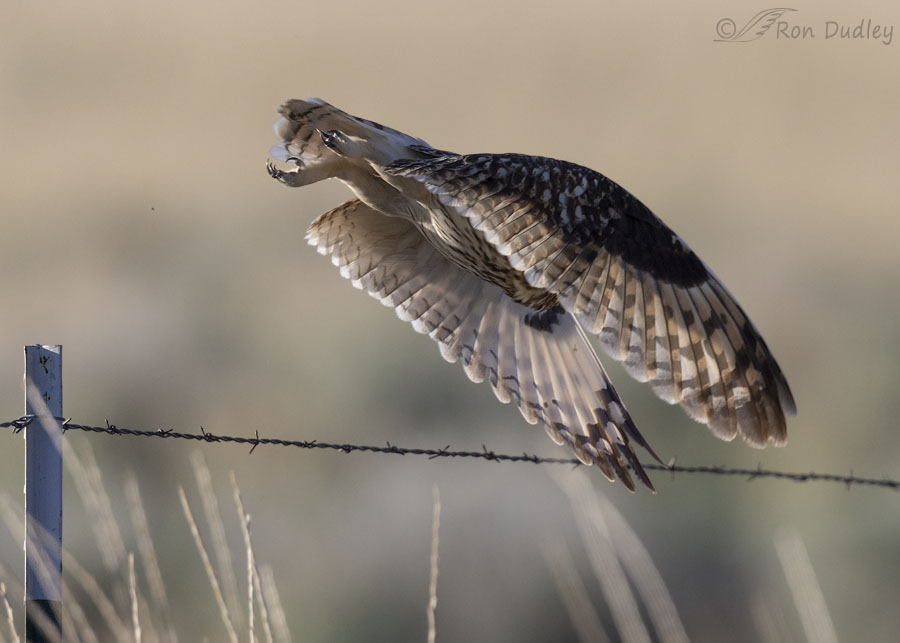
1/5000, f/5.6, ISO 800, Canon R5, Canon EF500mm f/4L IS II USM + 1.4 tc, not baited, set up or called in
diving on prey below him and to his left.
I got this single photo of him in this ass over teakettle flight posture, with his rear end significantly higher than his front end but his right wing covered his entire head, including his face and eye. I like this photo anyway but I’d love to have a photo where he’s still topsy-turvy but his wing isn’t hiding his face.
I probably had this owl in my viewfinder while he was in flight for about one second. If I’d been using my electronic shutter instead of my mechanical shutter, I’d have the potential of getting eight more photos (20 instead of 12) of him in flight, giving me a much better chance to get the photo I wish I had. It may not have happened, but it might have.
I’ll continue to shoot exclusively with the mechanical shutter but on rare occasions like this one I’ll also continue to wonder what I might have missed.
Ron
And now there are mirrorless cameras that let you take pictures BEFORE you press the shutter button! I expect that would have helped out with that diving owl!
Now I am going to have FOMO when I use my mirrorless! I already miss my 7d mkII when I shoot lightning. I had never thought about the mechanics of that mirrorless experience. Thanks for the relevant explanation.
Thanks for appreciating it, Suzanne.
Thanks for the education. Love all of your shots!
Thank you, Judy.
Thank you. Too many choices does my head in. I suspect I would find one way and stick with it, while from time to time wondering whether I was wrong. Again.
“I suspect I would find one way and stick with it”
That’s what I tend to do, EC. If nothing else you become very familiar with, and good at, doing it that way.
Yes, it’s definitely a quandary I sympathize with. My workaround: On my Canon R5 Mark ii I can set it for UP TO 30 fps (way more than I need). So what I do is pre-set my C3 button for 20fps (along with a fast shutter speed) if I think I’m looking to get a bird in flight, and the C2 button at 5fps (along with a much slower shutter speed) if I’m just wanting a bird on a perch and then I switch back and forth in basically an instant (both are set to electronic shutter). Sometimes I’ll make C1 non-continuous with the mechanical shutter, too. That said, I inevitably use C3 at times when I didn’t need it and have to delete a bucketful (OK, make that a “reservoirful”) of photos. Personal preference, of course, but I’d rather do that than miss the shot.
Thanks for sharing your strategy, Paul. Loved your shift to using “reservoirful”. 🙂
Interesting post! Thx for answering the question posed by Kris for us novices. Love the dive shot 😀
Thanks, Kathleen. Kris asks good questions.
So with the mechanical shutter, you are still hearing the click even at that 12 frames/sec – it must just be a little whirr? I just tried counting to 12 in 1 second, no can do!
And I look at the hundred photos of tulips from the tulip festival on my phone – how do I delete any of them, they are all so pretty, even the fuzzy ones!
So your discussion and the comments from Ed and Jim are fascinating. I cannot comprehend the choices you have to make.
“it must just be a little whirr?”
Or a war, Carolyn. I think it sounds a little bit like a relatively quiet machine gun – maybe closest to WWII’s BAR (Browning Automatic Rifle) whose firing rate is 10.8 rounds per second. When you have several photographers shooting together it really can sound like a war.
Your comment about deleting tulip photos reminded me of another reason I don’t like taking so many photos. They’re so hard (making the choice) and time consuming to cull.
Thank you for sharing some interesting information about “camera guts,” Ron. As I can barely get a decent shot with my iPhone, professional-level camera equipment is far beyond my wheelhouse so I enjoy learning. Looking at these two shots (and I REALLY like the ass-over-teakettle one!), I’d say that whatever choices you’re making are working! 😀
I hope that this fellow is progeny of the Shortie dad bringing in a vole for his impatient wife and the kids.💜
“I hope that this fellow is progeny of the Shortie dad bringing in a vole for his impatient wife and the kids.”
I doubt that, Marty. That Shortie dad and his “impatient wife” was many years ago in Montana. But there’s always a possibility that this owl is related to Galileo. I’d take that if it were true…
I’m good with either. 😃 Or perhaps he has an impatient wife at home too. 😉
I’m pretty sure he does, Marty. There was always a second owl hunting in the vicinity – probably this one’s mate.
Interesting! The “kazillion” photos to deal with is a real put off for me even with manual shutter. My attention span is far too short for that! 😉 I DO like the included dive shot tho!
Judy, with the R5 using the mechanical shutter I can set the burst rate to slower than 12 frames/sec. I don’t have that option with the electronic shutter – it’s fixed at 20 frames/sec.
Interesting Ron, but over the head of this 87 year old amateur photographer. I was out the other day and complementing a photographer’s outstanding in flight photos when he responding – not a big deal Everett, I have bird detection or bird stop – whatever it is called where the camera automatically locks onto the bird.
Can you explain that feature and maybe what cameras have it?
Everett, it’s probably what Canon calls Eye Detection AF. The AF finds the bird in the frame and then locks focus on the eye, even when the bird’s moving around in the frame. That’s when everything’s working right – it isn’t always.
Manufacturers other than Canon have something similar but I don’t know what they call it.
Your post had me ruminating on everything from life, life choices, Socrates, and the one that (may) have gotten away. I’ll spare you all that, and simply say that given the pros and cons you have presented I think your choice was the wise one. Yes, that photo is worth sharing.
Glad you like “that photo”, Michael.
Your first sentence made me chuckle.
You’ll recall on my Columbia trip, where I used electronic burst mode all the time, I drowned in photos, over-filling my traveling 1 TB external drive. It was a disaster.
I concluded I needed burst mode maybe 1-2% of the time, but that when I needed it is needed it quickly. So I created a custom button that toggles between continuous and single shots. I shoot electronic shutter all the time, and toggle back and forth as needed. The most recent time I needed burst mode was my encounter with the American Bitterns. It worked a treat.
Another option, anyway.
Jim, I find it difficult to anticipate which shutter mode I’d prefer ahead of time. When I’ve tried to, I usually made the ‘wrong’ choice. I hate having way too many photos.
So true, Ron. I am realizing the chore of image review and culling is not so fun when I come home from a full day of photographing birds in flight. As you also point out it is nice to have the high frame rate during action periods. I also notice that it is a cognitive challenge when you end up with tens of sharp BIF consecutive images. Something just doesn’t feel right about deleting perfectly sharp images. I did this the other day with Harrier images and had to tell myself that if I could not differentiate the sequence just keep two of them instead of 60 “identical”. Nevertheless, I absolutely love the Canon R5 m2. I shot with my favorite camera for years, the Canon 7D2 the other day since it was feeling left out, and it felt so slow ( clunk, clunk) compared to the (buzz) of the R5 shutter. Times have really changed in BIF photography.
“Times have really changed in BIF photography.”
That’s for damn sure, Ed.
I had to shoot with my old 7D2 just last week. My major problem with using it was trying to remember which buttons did what and where on the camera they were. In situations like that, muscle memory can bite you in the butt.
OK– here’s a simple-minded question from an old gal :
do you have these two options available to SWITCH from within the SAME camera, or is this strictly a question of choosing one kind of camera over another kind ? As you can tell, I’m totally ignorant, so please enlighten me ……..
Not simple-minded, Kris. I probably didn’t make that very clear.
Yes, you can switch back and forth with the same camera. You have that option.
But I never switch to electronic shutter because it’s almost impossible beforehand to anticipate which mode would be best for the unfolding situation. And then I’d have all those extra photos to deal with.
That’s what I do and don’t do. Others do it differently.