

Sometimes, what I hope birds will do, they do. Or very nearly so.
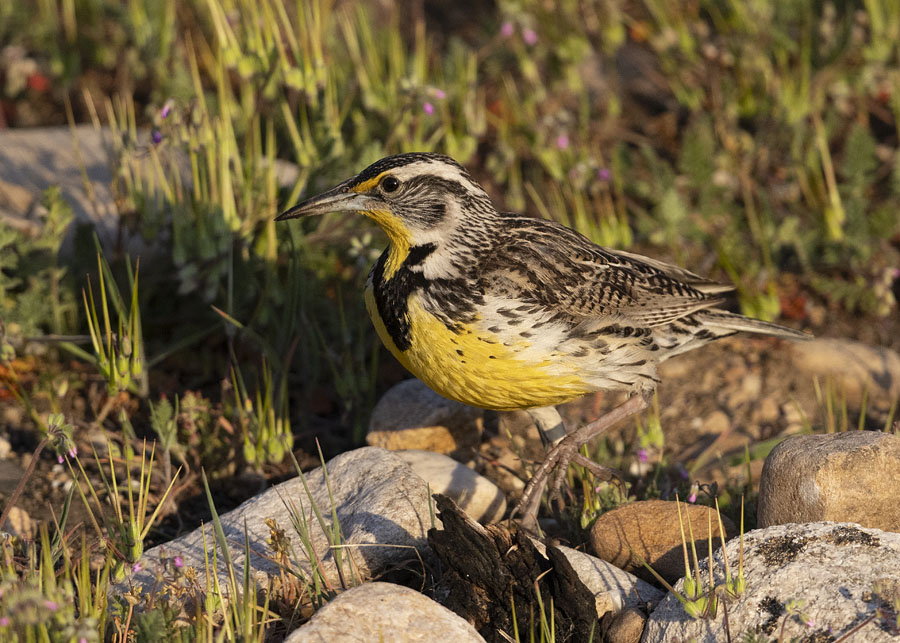
1/4000, f/5.6, ISO 1250, Canon R5, Canon EF500mm f/4L IS II USM + 1.4 tc, not baited, set up or called in
Four days ago I found this Western Meadowlark probing for food amongst a small pile of rocks in the fire scar of last July’s wildfire on Antelope Island. It’s wonderful to see that blackened scar recovering so nicely.
The meadowlark was close to me on a steep hillside, so although it may look like I was shooting down on ‘him’ (especially in the photo below), my lens was actually aimed pretty close to level.
I was hoping he would find a big fat juicy worm and eat it while I had him in my viewfinder.
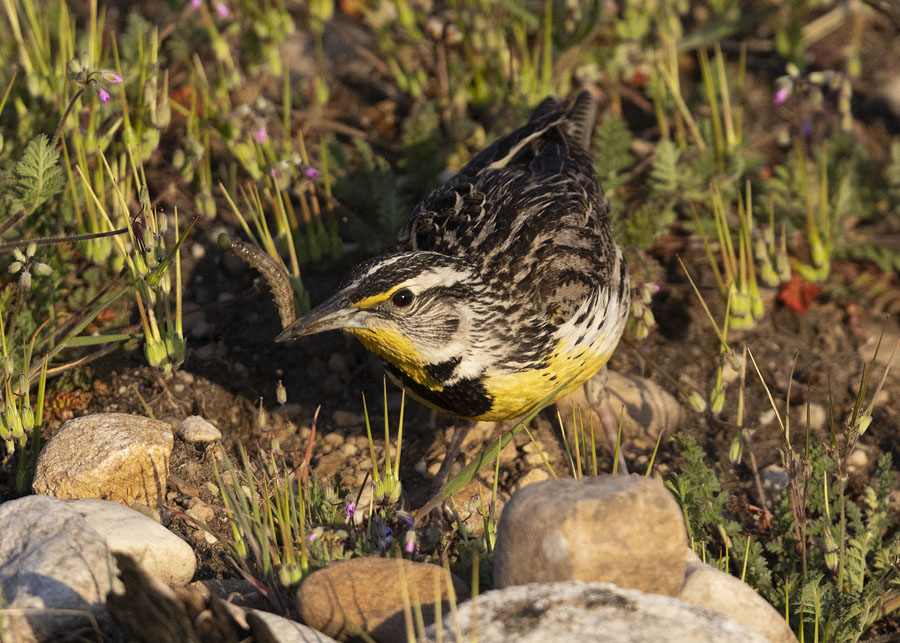
1/4000, f/5.6, ISO 1250, Canon R5, Canon EF500mm f/4L IS II USM + 1.4 tc, not baited, set up or called in
But what he plucked out of the ground next to one of the rocks was an insect larva instead of a worm (worms aren’t insects). When he tugged on it, the larva sprang almost straight up, providing a rather unusual image when combined with the atypical perspective that looks like I was shooting almost straight down on the bird. I wasn’t. The hillside was that steep.
He didn’t catch a fat ol’ worm but what he caught was close enough and he gobbled it down quickly. We were both satisfied.
Ron
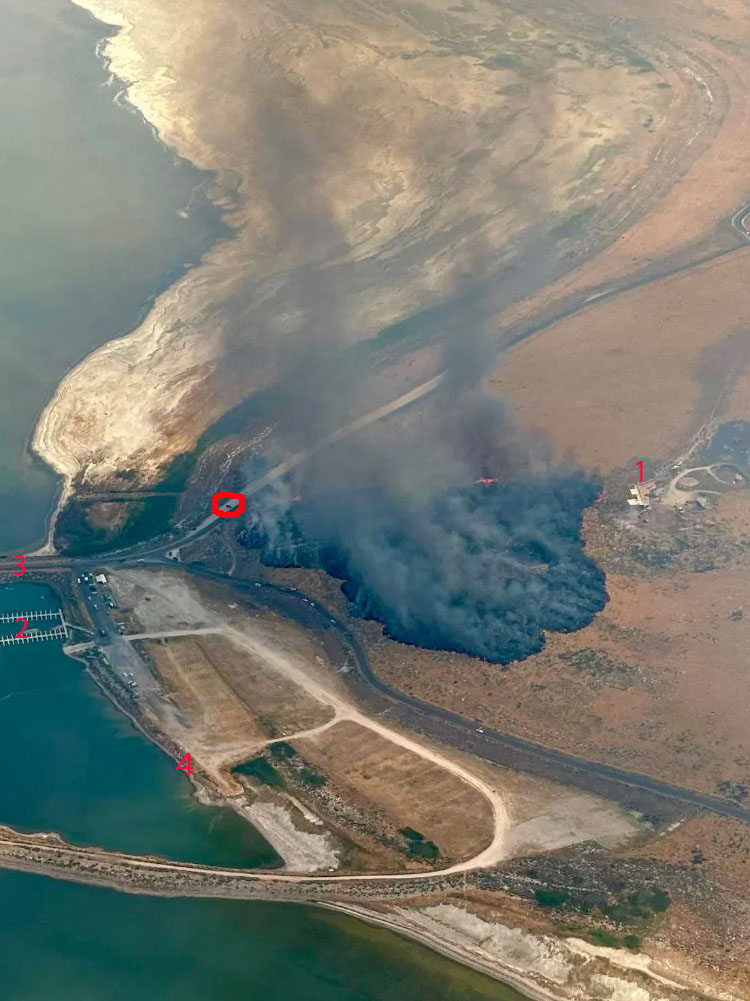
PS – In case you’re curious, this is an aerial photo of last year’s fire in progress. The vehicle I’ve circled in red is at almost the exact location I was when I took these meadowlark photos from my pickup.
Late addendum: I just now saw my first two hummingbirds, and my first house fly, of the season – almost simultaneously. Gotta take the bad with the good, I guess.
Fantastic story and photo’s! Thanks!
Great shot of a BEAUTIFUL bird- and light in the eye on both shots.
Thanks for sharing.
Thanks, Judy. Good for you for noticing the catch lights.
I am all too familiar with fire scar. And the slow and incomplete recovery.
I hope the Meadow lark enjoyed that juicy looking morsel – and thanks for explaining the perspective.. Not at all what I thought I was seeing.
“Not at all what I thought I was seeing.”
EC, that bird was close on the side of the steep hill and almost level with the bottom of my pickup window. In photos those circumstances skew a lot of things.
Nice to see succession happening at the scar and the Redstem Filaree playing its role. All those ripening pods sure capture the “Stork’s-bill” common name. We have one patch of our yard in which the only thing that ever grows is Redstem Filaree — at least the area is green during part of the year. 😂
Glad the meadowlark found a juicy, tasty tidbit. Curious as to what the adult form of that larva would be. The larval form looks very intriguing.
“Curious as to what the adult form of that larva would be.”
Me too, Marty. I should know but I don’t. I see what looks to be the same species of larva often, in various parts of the intermountain west – including southwest Montana.
Beautiful Meadowlark pics, they sing “spring” to me with the green grasses and those tiny, pink, bell-shaped flowers around the bird. Glad he caught the meal he was after, and you caught the action. 😎
And glad the fire scar area is recovering. I’ve heard that fires burn so much hotter and longer today, recovery isn’t always a sure thing. At least not in our lifetimes.
Glad you like the photos, Chris. Fires in these desert areas tend to burn and travel pretty fast.
Always love a meadowlark! I wonder if the larva sprang upward to look scary to a predator. (It didn’t help.) I don’t know much about insects — that’s for sure!
Ellen, the only reason the larva “sprang upward” was because the meadowlark had been tugging on it when it released from the ground. Kinda like a rubber band…
Very nice photos, the burn scar seems to attract wildlife or maybe we can just see it now. Just got my first male broad-tail hummer this morning. At least the first I have seen. I have been working a lot and out of town the past couple of weeks.
Thanks, April. Nice to have the hummers coming back.
Nice photos Ron. I love seeing Meadowlarks – they really take me back to my youth in West and Central Texas, where they were very abundant. Also great to see the recovery of the burn scar- I’m afraid we’re going to need that kind of resilience more and more.
I’m afraid you’re right, Bill. Thanks.
Very sharp and Michael mentioned and pretty good considering all that surrounds the bird. Love the Meadowlarks. I don’t think I ever saw one before moving to Prescott.
After these so destructive fires nature always comes back to restore the area. Before we humans covered most of the earth those fires would have just burned and burned till they burned themselves out.
Thanks, Everett. I’d have thought you’d see Eastern Meadowlarks when you lived back there.
sensational series
Thanks.
A meal is a meal! 😉 Beautiful shots and I’m also glad the burn scar is recovering well.
Thanks, Judy.
Those are amazing shots of a Western Meadowlark. So vivid and sharp in detail, and with a natural setting.
Thanks for noticing the sharpness, Michael. They’re so sharp I had to reduce my normal sharpening routine by 50%. Otherwise they looked “crinkly”.